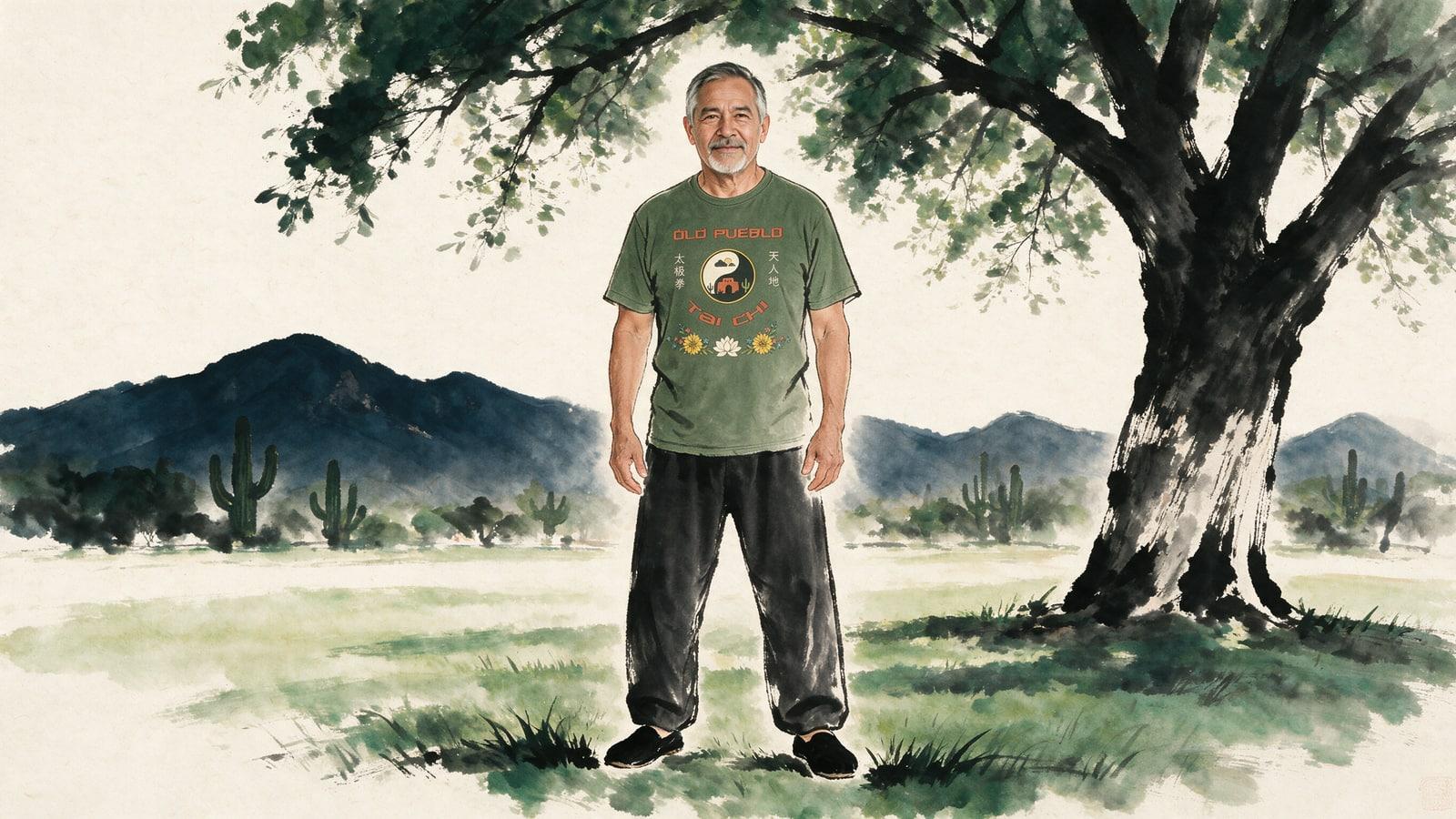
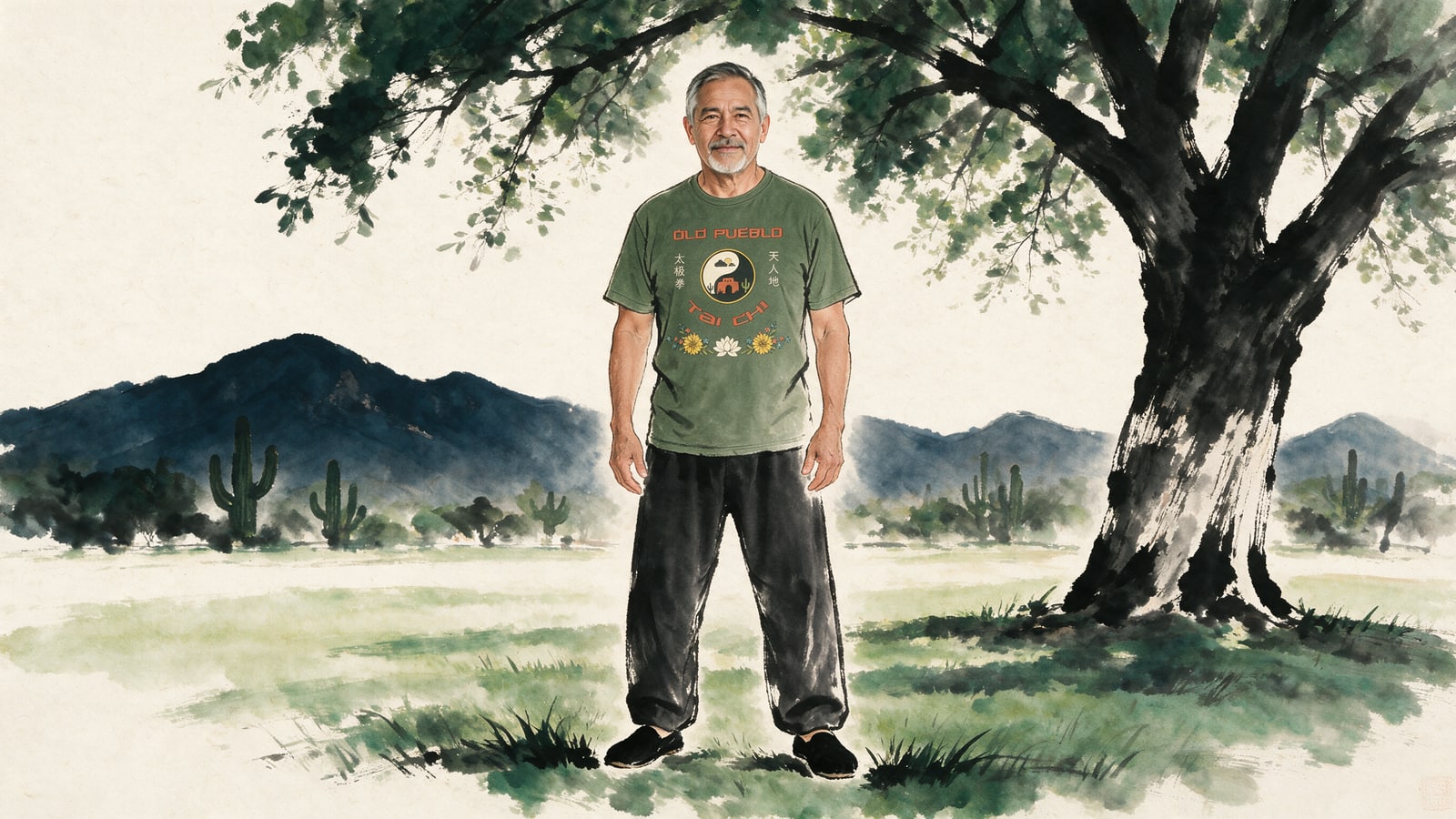
Have you ever wondered about the symbols and Chinese characters on our Old Pueblo Tai Chi and Old Pueblo Qigong logos?
Every detail in the artwork was chosen to connect our home in Tucson—affectionately known as the “Old Pueblo”—with the simple, calming practices of Tai Chi and Qigong. Whether you have seen the designs around the studio or on our Old Pueblo Tai Chi & Qigong Tee Shirts, here is a quick guide to what you are seeing.
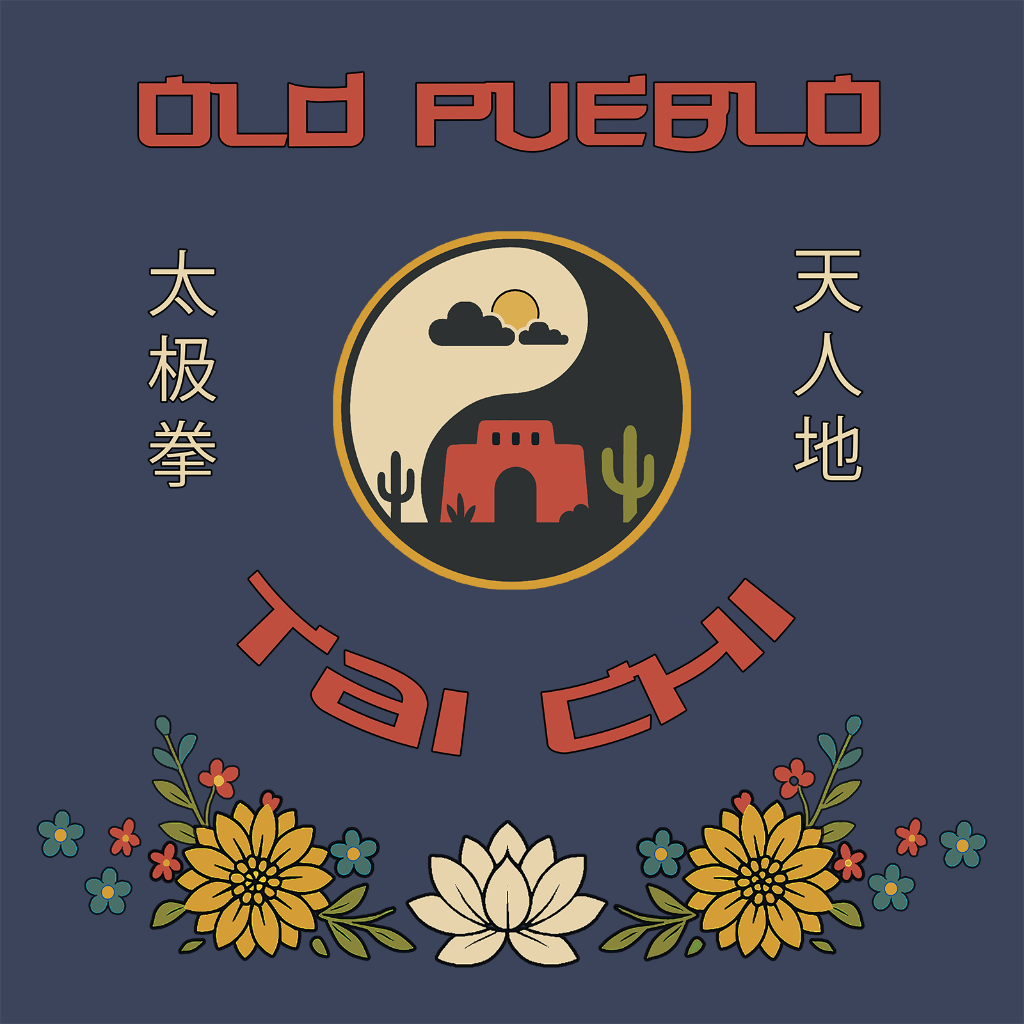
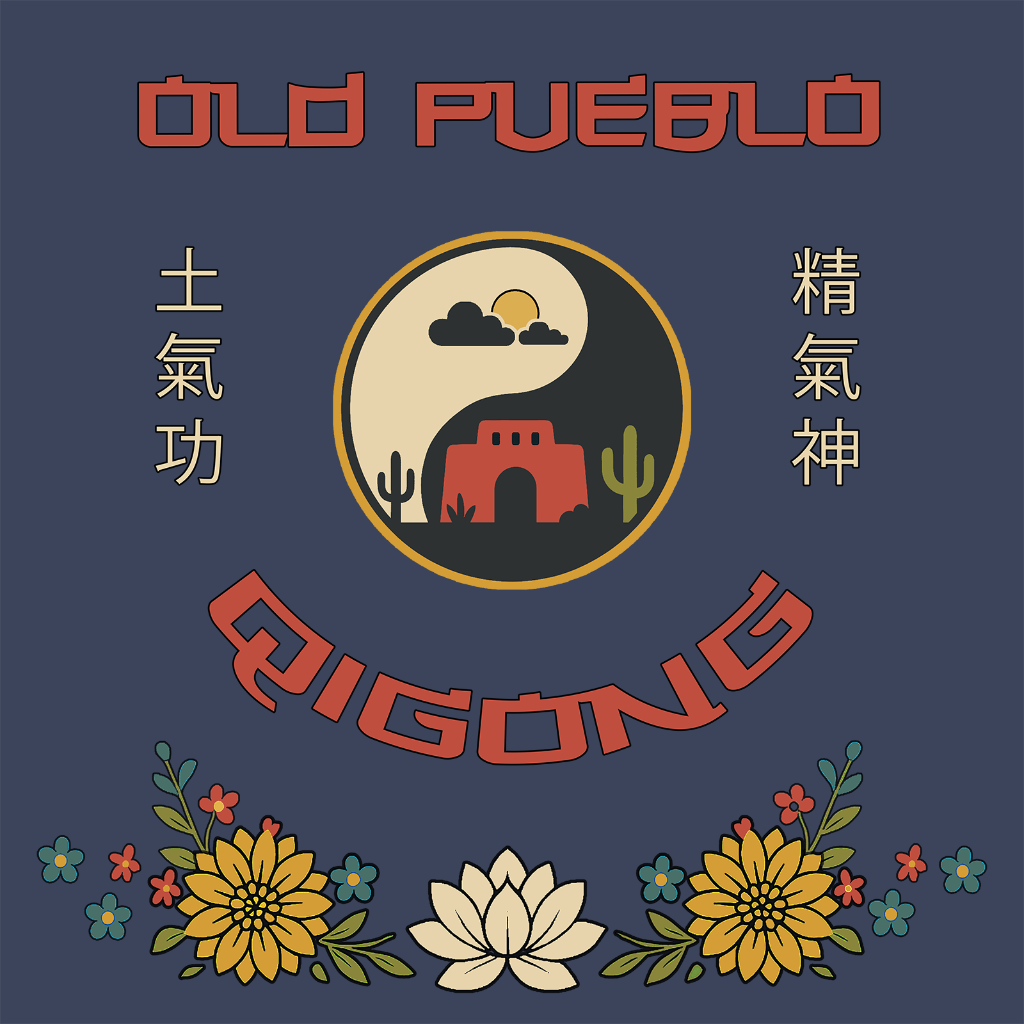
☯️ The Center Circle: Balance in the Desert
At the middle of both logos is a Tucson take on the classic Yin-Yang circle, a timeless symbol showing how opposites in nature work together in harmony:
- The Light Half: Features a warm golden sun rising behind clouds in a cream sky.
- The Dark Half: Features a terracotta-red adobe building in cool evening shade.
In class, we practice this same kind of balance—pairing gentle movement with calm stillness, and steady posture with relaxed breathing.
“The fundamental rhythm of all energy fields is the interplay of yin and yang—the two interrelated energies in the famous Taoist symbol that weaves together light and dark.”
— Master Kam Chuen Lam, The Qigong Workbook for Anxiety
🌸 The Flowers at the Bottom
Beneath the bold terracotta-red lettering sits a garland of flowers from two worlds:
- A Cream Lotus Flower in the Center: In East Asian culture, the lotus is a favorite symbol of peace and resilience because it grows up through muddy pond water to bloom clean and bright in the sun.
- Desert Wildflowers on Both Sides: Golden desert marigolds, sage-green leaves, and tiny turquoise and terracotta blossoms surround the lotus, celebrating the everyday beauty of the Sonoran Desert.
🖌️ The Chinese Characters: What They Say (From Top to Bottom)
Each logo has two columns of Chinese characters on the left and right. Even if you have never read a Chinese character before, their meanings are simple and practical:
On the Tai Chi Logo
Left Side — 太極拳 (Tai Chi Chuan): The full traditional name for Tai Chi, a gentle martial art and moving meditation practiced for balance, joint health, and relaxation.
Right Side — 天人地 (Heaven, Human, Earth): Written from top to bottom, it places Human (人) right between Sky (天) and Ground (地). It is a visual reminder of good Tai Chi posture: keep your feet rooted on the ground and stand tall toward the sky.
On the Qigong Logo
Left Side — 土氣功 (Earth Qigong): Combines Earth (土) with Energy/Breath (氣) and Practice (功). It honors Tucson’s adobe earth while reminding us to slow down, feel the ground beneath our feet, and recharge our energy through Qigong.
Right Side — 精氣神 (The Three Treasures): Represents the three things we nurture every time we practice—a healthy Body (精), steady Breath and Energy (氣), and a calm, clear Mind (神).
🌿 How It Feels in Movement: Standing Between Sky and Earth
New students often ask before their first visit: “Do I need a special uniform to come to Tai Chi class?” Never! All you ever need is comfortable everyday clothing that lets you move and breathe easily.
If you would like to wear our Tucson studio crest to morning practice, out at Reid Park for World Tai Chi & Qigong Day, or on a neighborhood walk, both the Tai Chi Logo and Qigong Logo are available on our soft Unisex Classic Crewneck and Women’s Relaxed V-Neck tees:
Old Pueblo Tai Chi & Qigong Tee Shirts ($22)
Choose Crewneck or Women’s V-Neck in your favorite color and size (S–2XL) for in-class pickup.
🥋 Studio Cue: Before we begin moving in class, take a moment to feel the three characters on our Tai Chi logo—Sky, Human, Earth (天人地). Let your feet rest flat and heavy on the floor (Earth), soften your knees and shoulders, and let the top of your head float lightly toward the ceiling (Sky) so you stand tall and relaxed right in the middle.
🪑 Gentle Adaptation: You can feel this exact same connection between Sky and Earth while seated. Sit near the front edge of your chair with both feet flat on the floor, let your shoulders drop away from your ears, and breathe comfortably into your lower ribs and belly.
✨ Key Reflections to Carry With You
- Balance in nature and in movement: Like the sun and shade inside our desert Yin-Yang circle, Tai Chi and Qigong pair steady structure with unhurried ease.
- Stand between sky and earth: Let your feet rest solidly on the floor while the crown of your head floats lightly upward.
- Explore our studio shirts anytime: You can browse all colors and sizes of our Tai Chi and Qigong shirts on our Tee Shirts & Practice Gear page.
Old Pueblo Tai Chi — Traditional Yang & Sun Style Classes
Culture Connects Studio • 3000 E. 22nd Street, Tucson, AZ 85713 • https://oldpueblotaichi.com
Questions about classes? Contact Dan Kimball at dan@oldpueblotaichi.com