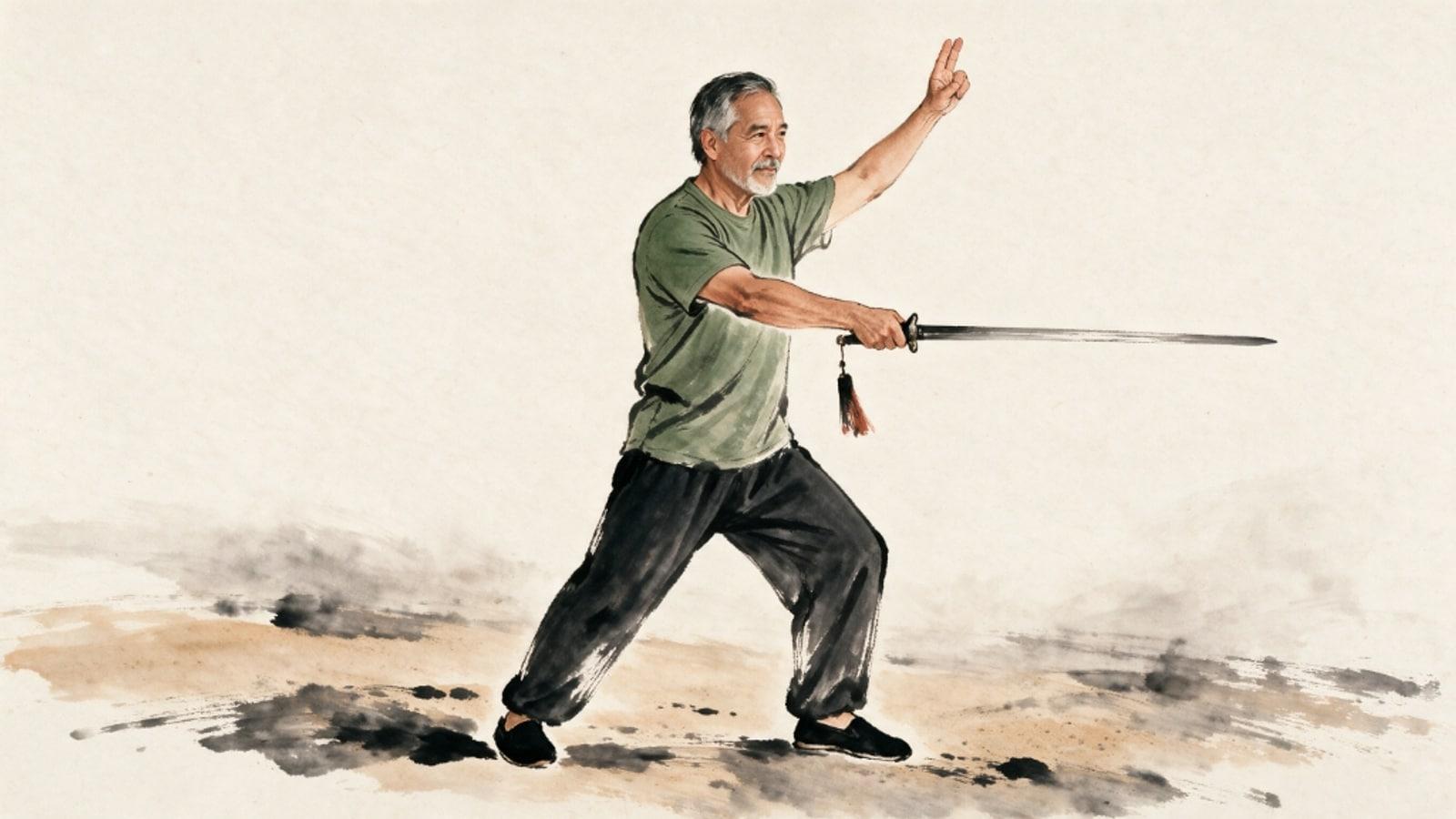
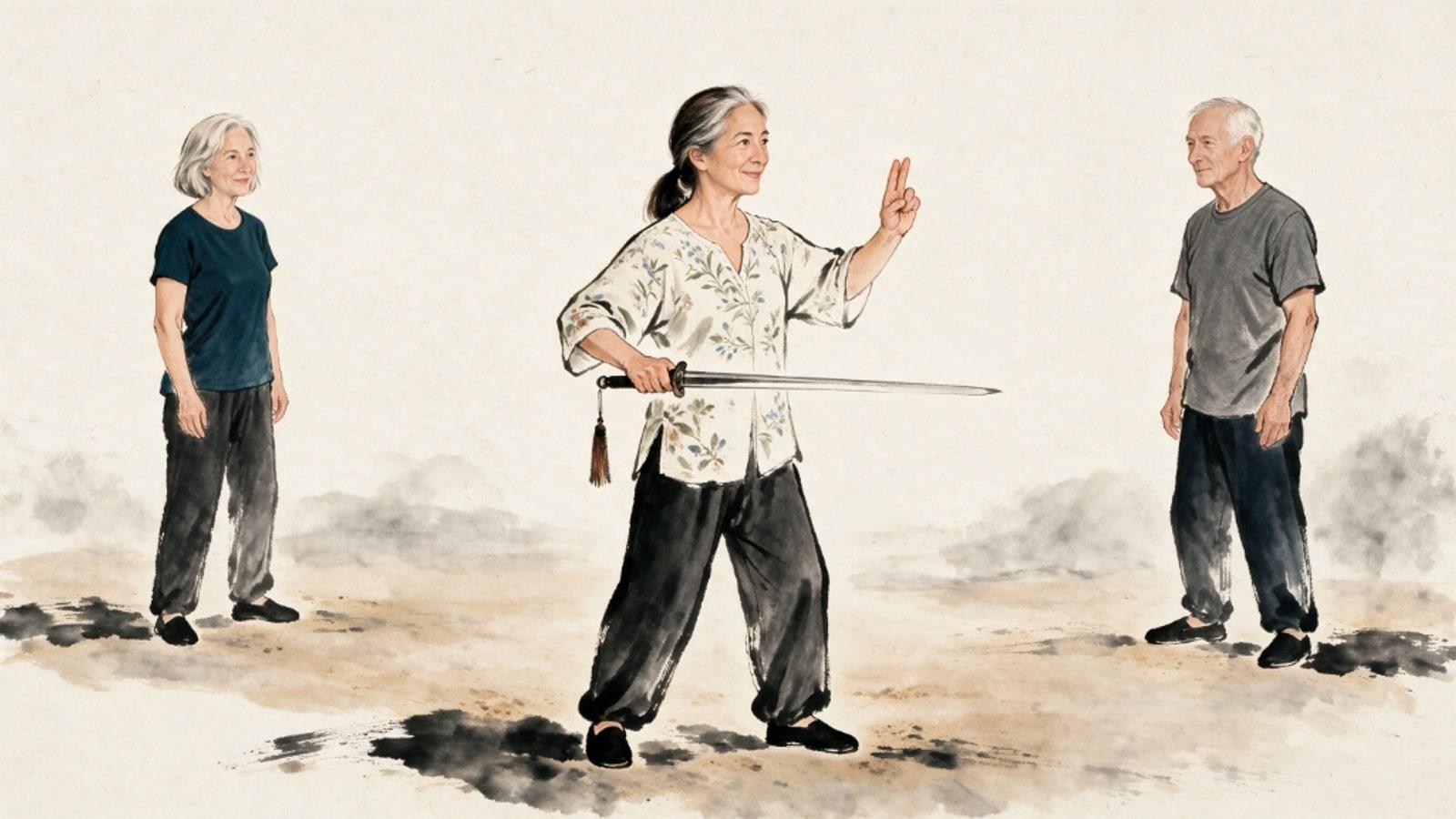
If you have ever watched someone practice Tai Chi Sword in a quiet park or sunlit studio, you probably noticed right away that it looks nothing like movie swordplay. There is no clashing or rushing. Instead, the practitioner moves like water—gliding from one foot to the other while a slender, tasseled blade traces smooth circles in the air.
At Old Pueblo Tai Chi in Tucson, new students often ask a very practical question:
“I came here for better balance, calmer breathing, and healthier knees—why would I ever hold a sword?” Yet the moment they try holding a featherweight wooden or
retractable practice sword, the answer becomes clear.
A light sword acts like a friendly magnifying glass for your posture. If you hike your shoulders or grip too tightly, the tip wobbles. When you relax your shoulders and move from your center, the blade floats effortlessly.
☯️ Why the Straightsword Is Called the “Gentleman of Weapons”
In Chinese tradition, the double-edged straightsword—known as the Jian (劍)—has been practiced for more than two thousand years not as a tool of aggression, but as an instrument of calm focus and personal refinement. Classical teachers called it the “Gentleman of Weapons” because you cannot wield it with brute strength. To move it smoothly, your mind has to be quiet and your joints have to stay soft.
“Differentiate the real and the apparent, regulate breathing, use mind rather than brute strength, be calm and relaxed in your action.”
— Wong Kiew Kit, The Complete Book of Tai Chi Chuan
In 1957, master teachers in China wove the most beloved movements of traditional Yang-style sword work into the 32-Posture Tai Chi Sword Routine. Arranged in four short sections that flow down and back across the floor, it remains the most welcoming sword routine in the world for students who already know a little barehand Tai Chi and want a fresh, enjoyable challenge for their coordination and memory.
🌿 How It Feels in Movement: Three Everyday Benefits of Sword Practice
You do not need any martial arts background to enjoy what a light practice sword does for your body. Here are the three biggest changes students feel within their first few weeks:
1. Instant Feedback for Tight Shoulders and Wrists
Most of us carry hidden tension in our neck, shoulders, and hands from driving, typing, or holding a phone. When you hold a four-ounce practice sword with a soft “paintbrush grip”—wrapping primarily with your middle, ring, and little fingers while keeping your index finger and thumb relaxed—your arm naturally lengthens and your shoulder drops away from your ear.
2. Graceful Counterbalance With Your Opposite Hand
While your right hand guides the sword, your left hand doesn’t just hang at your side. Its index and middle fingers rest gently together in a soft hand posture called Sword Fingers. As the sword reaches forward, your opposite arm floats backward or overhead like a dancer’s counterbalance, gently opening your chest and upper back.
3. Playful Imagery That Keeps Your Mind Present
Each movement in the 32-posture routine has a poetic name drawn from nature—like Dragonfly Skims the Water, Swallow Returns to Its Nest, or Phoenix Spreads Its Wings. Picturing a dragonfly lightly touching a pond helps you step softly and keep your knees comfortable.
Click to View the 32 Posture Names (Optional Reference)
Opening: Point the Sword with Feet Together • Immortal Points the Way
Group 1: Three Rings Around the Moon • Big Dipper • Swallow Skims the Water • Block Left & Sweep Right • Little Dipper • Swallow Returns to Its Nest • Clever Cat Catches the Mouse • Phoenix Lifts Its Head
Group 2: Wasp Enters the Cave • Phoenix Spreads Right Wing • Little Dipper • Phoenix Spreads Left Wing • Waiting for Fish • Parting the Grass • Embrace the Moon • Flocking Birds Return to the Forest
Group 3: Black Dragon Wags Its Tail • Wind Rolls the Lotus Leaves • Lion Shakes Its Head • Tiger Holds Its Head • Wild Horse Leaps the Ravine • Turn the Body & Rein In the Horse • Compass Point • Wind Dusters
Group 4: Push the Boat With the Current • Shooting Star Chases the Moon • Heavenly Steed Flies Across the Sky • Lift the Curtain • Wheel Sword Left & Right • Swallow Holds Clay in Its Beak • Closing Posture
🥋 Studio Cue: Before you buy a sword, practice holding a simple wooden kitchen spoon or a rolled-up magazine. Let your shoulder melt downward and guide the tip across the room by turning your waist rather than muscling with your arm.
🪑 Gentle Adaptation: The upper-body circles of Tai Chi Sword feel wonderful from a sturdy chair or while standing in a comfortable high stance. If standing on one leg feels wobbly during postures like Golden Rooster, simply rest your lifted toes lightly on the floor like a kickstand while your arms enjoy the full movement.
✨ Key Reflections to Carry With You
- Softness guides the blade: A practice sword rewards relaxed shoulders and a soft grip far more than arm strength.
- Your whole body moves as one: Turning your waist and shifting your weight smoothly is what makes the sword glide without strain.
- Calm focus comes naturally: Following the tip of the sword with soft eyes gives a busy mind a peaceful, single point of focus.
Old Pueblo Tai Chi — Traditional Yang & Sun Style Classes
Culture Connects Studio • 3000 E. 22nd Street, Tucson, AZ 85713 • https://oldpueblotaichi.com
Questions about classes? Contact Dan Kimball at dan@oldpueblotaichi.com