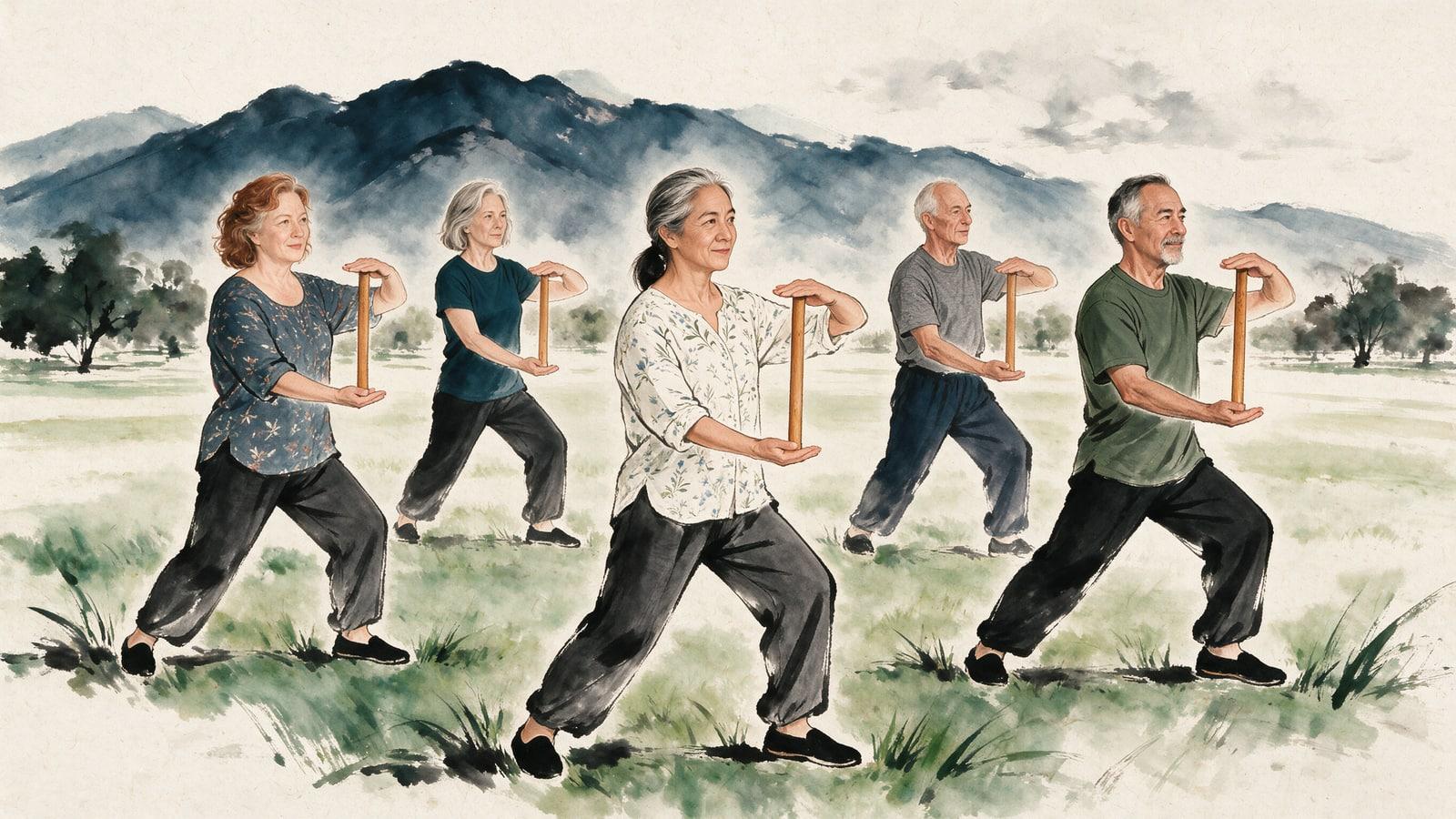

In our morning classes in Tucson, one of the smallest cues we practice often brings the most surprised smiles. Just before we begin our opening posture, you will hear a gentle reminder: “Let your teeth part slightly, soften your jaw, and rest the tip of your tongue lightly behind your upper front teeth.” Inevitably, a new student will smile and ask why such a tiny, hidden detail matters when we are trying to remember what to do with our feet and hands.
In everyday life—whether we are driving across town or concentrating over a screen—we tend to brace from the neck up. We clench our back molars, hold our breath high in the chest, and carry tight shoulders without even noticing. In Tai Chi and Qigong, resting the tongue lightly on the roof of the mouth acts like a quiet switch: it releases hidden jaw tension and invites your breath to settle into a smooth, calming loop.
☯️ The Story of the Magpie Bridge (Queqiao 鵲橋)
Rather than turning this posture cue into a dry anatomy lesson, traditional Chinese teachers explained it through a beloved stargazing story: the legend of the Cowherd and the Weaving Girl. Separated across the starry river of the Milky Way, the two lovers can only reunite once a year when all the magpies in the world fly upward wing to wing, forming a living Magpie Bridge (Queqiao 鵲橋) across the sky.
“The silver river (Milky Way) separates the meeting of Yin and Yang. It must rely on the magpie bridge to cross. Man’s tongue is regarded as a magpie bridge. When training Gong, the tongue touches the palate of the mouth to connect Yin and Yang.”
— The Mirror of Cui’s Method of Entering the Herb (quoted by Dr. Yang, Jwing-Ming, Qigong Meditation: Small Circulation)
In classical Qigong, your body has two main pathways of energy that mirror that night sky:
- The Rising Back Pathway (Du Mai 督脈): A warm, energizing current that travels steadily up the centerline of your spine to the crown of your head, supporting tall, upright posture.
- The Calming Front Pathway (Ren Mai 任脈): A cool, settling current that flows down the front of your face, chest, and belly, helping your shoulders and ribcage unwind.

Just like the two stars across the Milky Way, these back and front pathways meet at the mouth. When you rest the tip of your tongue gently behind your upper teeth, you build the Magpie Bridge—completing a peaceful circular breathing loop known as the Small Heavenly Circle (Xiao Zhou Tian 小周天), or the Microcosmic Orbit.
🌿 How It Feels in Movement: Three Simple Steps to Complete the Loop
You never need to force your breathing or memorize complicated charts to feel this connection. Moving within a comfortable 70 percent effort zone, try checking these three easy steps before your next practice:
1. Unlock Your Knees and Soften Your Hip Crease
Begin in quiet standing with your feet shoulder-width apart. Unlock your knees an inch and let your hip crease soften as if perching on the edge of a tall stool. Feel the soles of your feet rest warmly on the floor while the crown of your head floats tall like a ponderosa pine on Mount Lemmon.
2. Unclench Your Back Teeth and Build the “Magpie Bridge”
Let your lips close softly so you can breathe quietly through your nose. Leave a little breathing room between your back teeth, and rest the tip of your tongue lazily against the smooth ridge right behind your upper front teeth. Notice how softening your jaw immediately invites active relaxation down into your neck and shoulders—and helps keep your mouth naturally moist during class.
3. Breathe Up the Spine and Down the Front
With your tongue resting lightly in place, follow your natural breath for three slow cycles. As you inhale through your nose, picture a gentle warmth rising up your back to the top of your head. As you exhale, let that warmth cross the bridge of your tongue and flow down the front of your chest into your lower belly—like water trickling down a quiet stream in Sabino Canyon after a summer rain.
🥋 Studio Cue: Try the “Jaw-and-Shoulder Check.” Clench your back teeth together for two seconds and notice how the sides of your neck subtly tighten. Now part your back teeth, rest the tip of your tongue lightly behind your upper front teeth, and let out a slow breath. You can feel your collarbones and shoulder blades drop on their own.
🪑 Gentle Adaptation: Practicing this gentle breathing loop while seated is one of the easiest ways to refresh yourself during the day. Sit near the front edge of a sturdy chair with your feet flat on the floor—or try it while waiting at a long red light on Speedway—resting your tongue lightly on the roof of your mouth for three slow belly breaths.
✨ Key Reflections to Carry With You
- A soft jaw brings soft shoulders: Leaving a little space between your back teeth and resting your tongue lightly on your palate releases tension all the way down your neck.
- Follow your breath, never force it: Let your inhale naturally lengthen your spine and your exhale settle warmly down into your belly.
- Carry the bridge into everyday life: Whenever you feel hurried or tense during the day, touching the tip of your tongue behind your upper teeth is a quiet reminder to slow down.
Old Pueblo Tai Chi — Traditional Yang & Sun Style Classes
Culture Connects Studio • 3000 E. 22nd Street, Tucson, AZ 85713 • https://oldpueblotaichi.com
Questions about classes? Contact Dan Kimball at dan@oldpueblotaichi.com