
In a culture that measures fitness by how fast we move or how hard we push, standing quietly in one place can feel almost surprising. Yet for centuries, Tai Chi and Qigong teachers have turned to standing meditation—often called “standing like a tree”—as one of the most direct ways to build leg and hip strength, quiet a busy mind, and release everyday shoulder tension.
To someone walking by, a student practicing standing meditation looks completely still. Inside the body, however, a gentle reset is taking place: tight shoulders soften downward, the breath settles comfortably into the lower belly, the arches of the feet wake up, and the bones stack cleanly over the floor.
☯️ Standing Like a Tree (Zhan Zhuang 站樁)
Known in Chinese as Zhan Zhuang (站樁)—pronounced Jan Joo-ong—this practice translates literally as “standing like a rooted post” or “standing like a tree.” Together, the two characters paint the picture of a sturdy desert mesquite or mountain pine: its roots sink deep into the earth below, its trunk rises tall and steady, and its upper branches remain relaxed enough to sway with the breeze without stiffening.
“Begin by standing still. This is the practice that refines the flow of energy throughout the human body. Zhan zhuang transforms the weak into the strong and makes the awkward agile.”
— Grand Master Wang Xiang Zhai (quoted in Master Kam Chuen Lam, The Qigong Workbook for Anxiety)
While quiet standing dates back more than two thousand years in early Chinese wellness classics, it was made accessible to everyday students in the twentieth century by teachers like Wang Xiangzhai, who stripped away complicated footwork so anyone could experience the health benefits of calm, rooted posture.
A Personal Studio Reflection: Studying with Grandmaster Puquan Xiao
In the spring of 2017, while training at 9 Dragons Healing Arts, I had the humbling opportunity to complete a six-week Medical Qigong intensive with Grandmaster Puquan Xiao, a 33rd-generation Shaolin monk and doctor of Oriental Medicine. Every Saturday for two and a half hours, we immersed ourselves in the quiet practice of standing meditation.

From our very first session, Grandmaster Xiao reminded us that standing is never stiff or military. After loosening the joints with gentle Qigong warm-ups, we stood together—beginning with just a few minutes and gradually building toward twenty and thirty minutes of unhurried stillness. With minimal words and a warm, steady presence, he adjusted the angle of a knee, the drop of an elbow, or the tall lift of the head, teaching us to align the lower belly for balance, the chest for emotional calm, and the mind for clear, unhurried awareness. What stayed with me most was how standing still created what he called a “clear space” inside—bringing deeper sleep, steadier daily energy, and a quiet resilience that carried far beyond the studio floor.

🌿 How It Feels in Movement (and Stillness): Two Foundational Postures
In our Tucson classes, we practice two simple standing postures that bring together a comfortable stance, an easy breath, and a quiet mind.
1. Quiet Standing (Arms Resting Naturally at Your Sides)
Stand with your feet shoulder-width apart and parallel, knees softly unlocked, and arms hanging comfortably at your sides. Imagine a light thread lifting the crown of your head toward the ceiling while your hips and heels settle heavily into the floor. Within a few breaths, you can feel the day’s hurry begin to fade.
🥋 Studio Cue: Scan gently from the top of your head down to the soles of your feet. Whenever you notice a muscle working harder than it needs to—in the jaw, the tops of the shoulders, or the grip of the toes—invite it to soften by ten percent.
2. Embracing the Tree (Holding a Gentle Circle in Front of the Chest)
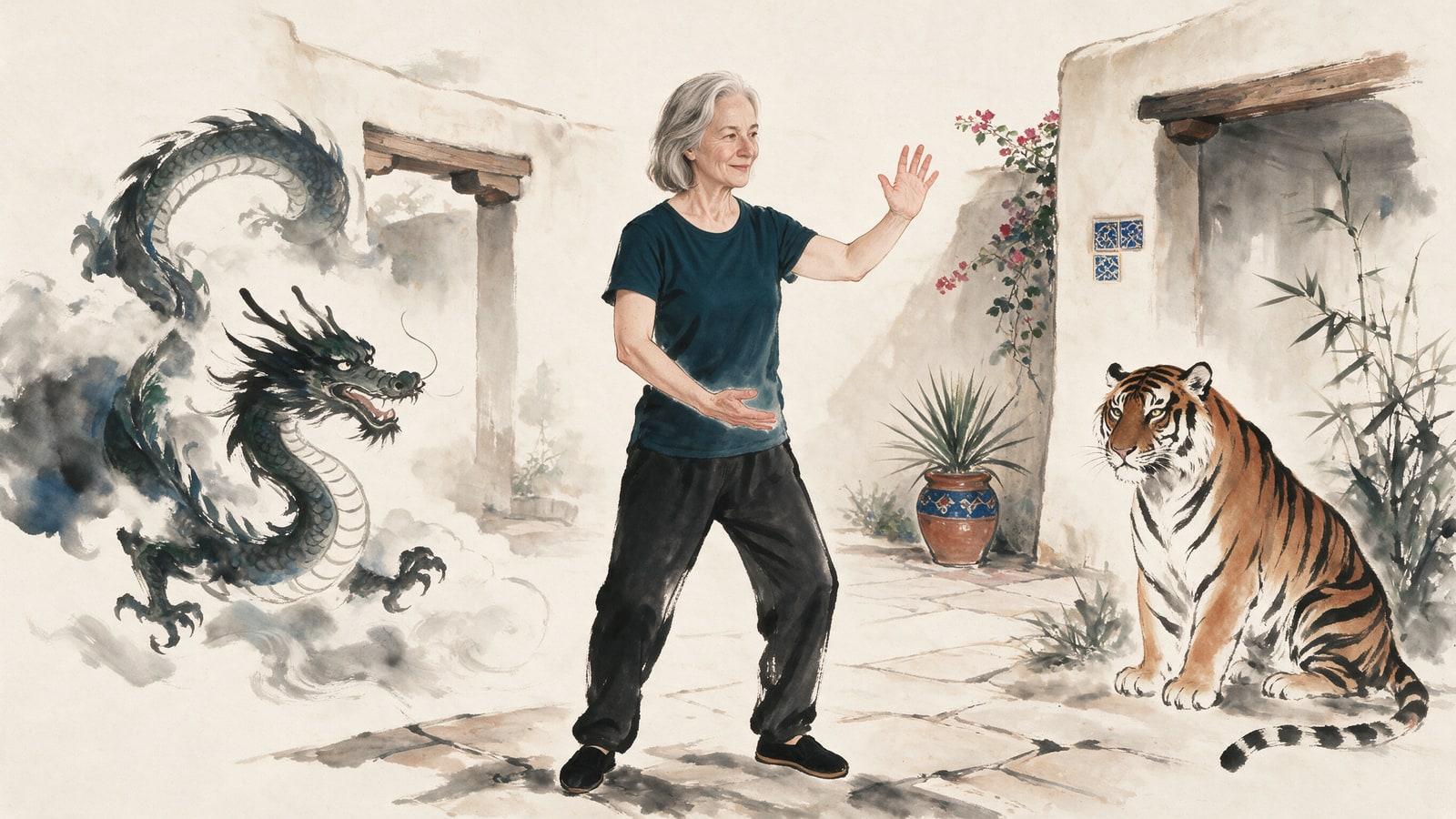
From quiet standing, float both arms up in front of your chest as if gently hugging the trunk of a wide shade tree. Keep your elbows slightly lower than your wrists and shoulders, leave comfortable breathing room under your arms, and let your palms face gently inward with soft, relaxed fingers.
After two or three minutes, you may notice a pleasant warmth in your hands or a light work in your thighs as your deeper posture muscles wake up. Nothing needs to be forced—simply bring your attention back to the slow rise and fall of your breath and the solid floor beneath your shoes.
🪑 Gentle Adaptation: Begin with just two to three minutes a day in a tall, comfortable stance with only a soft bend in the knees. If your shoulders get tired holding your arms at chest height, lower your hands to rest lightly in front of your lower belly, or practice the exact same tall spine and rounded arms while sitting upright near the front edge of a sturdy chair with both feet flat on the floor.
✨ Key Reflections to Carry With You
- Stillness is active care: Standing quietly for even three minutes shows us where we hold extra tension and teaches our bones to support us with ease.
- Consistency matters far more than duration: Three relaxed minutes every morning will help your balance and posture far more than a long session held through strain.
- Calm returns on its own: Like desert dust settling in a glass of water, steadiness returns naturally when we give ourselves permission to pause.
Old Pueblo Tai Chi — Traditional Yang & Sun Style Classes
Culture Connects Studio • 3000 E. 22nd Street, Tucson, AZ 85713 • https://oldpueblotaichi.com
Questions about classes? Contact Dan Kimball at dan@oldpueblotaichi.com