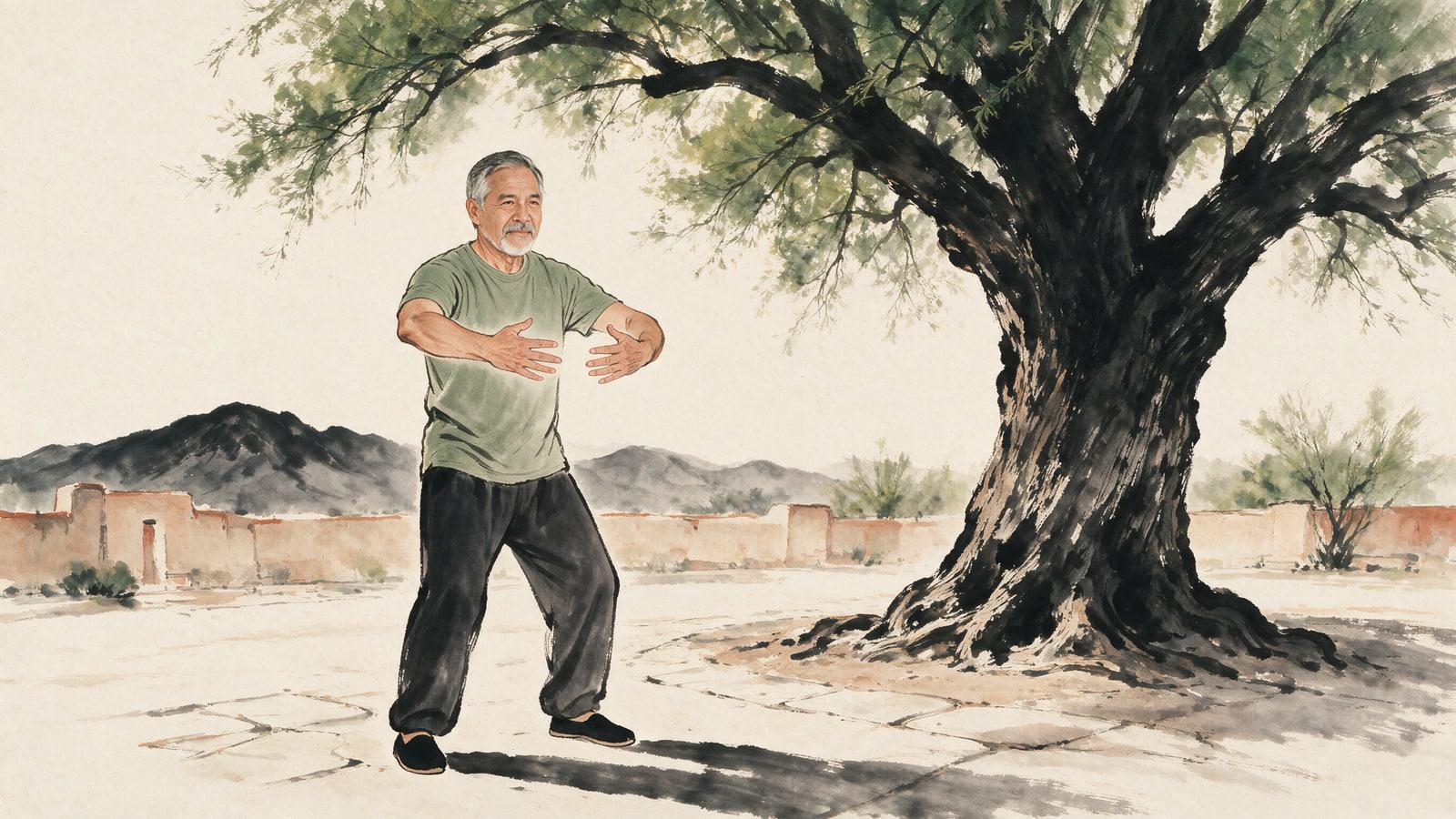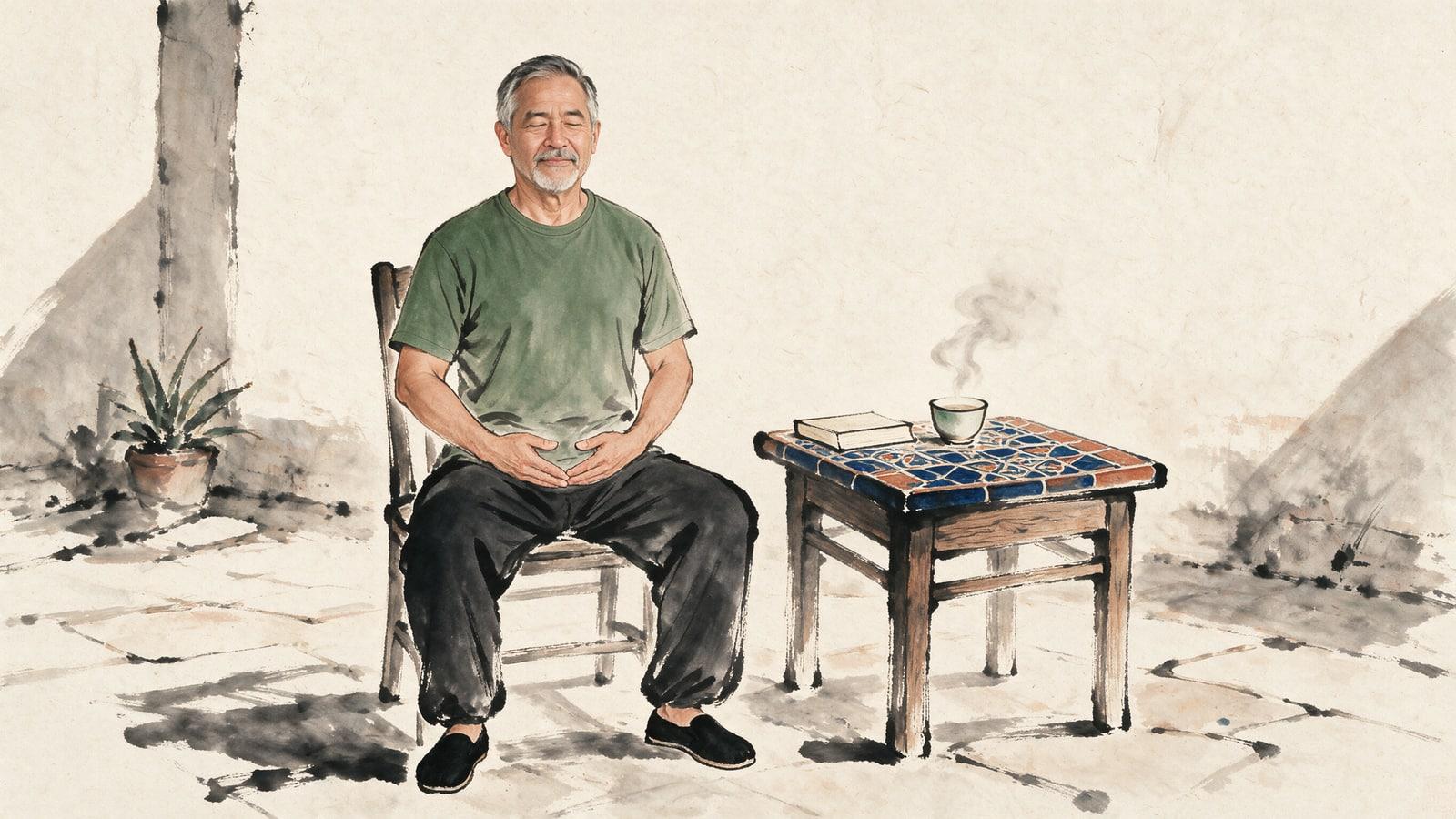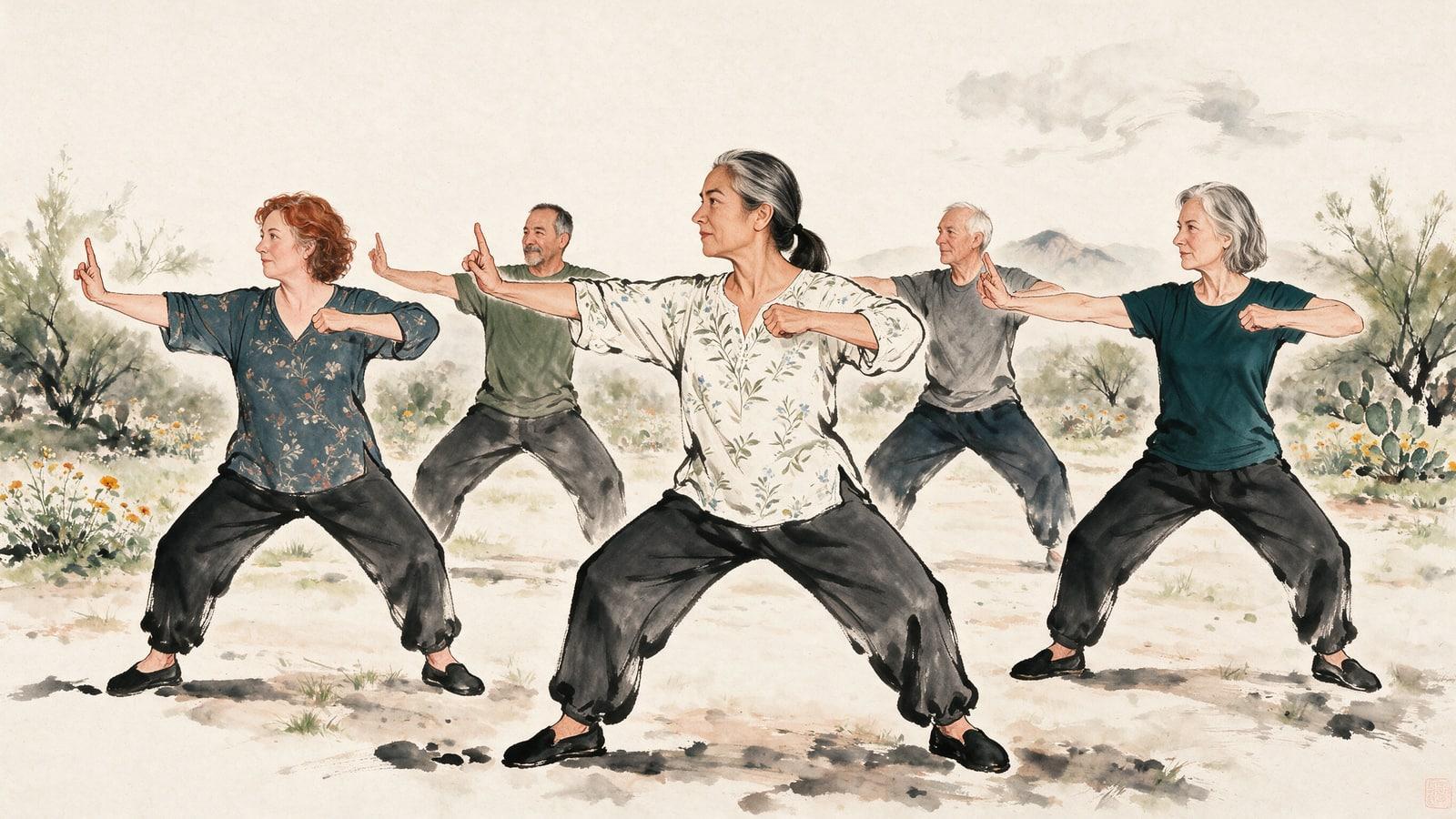

When we stretch our arms overhead or turn our waist in a morning Qigong class here in Tucson, it is fun to wonder: how long have human beings been doing these exact gentle exercises to take care of their backs, knees, and spirits?
In 1973, archaeologists in Changsha, China found a breathtaking visual answer. Inside a sealed Han-dynasty tomb dated to 168 BCE—more than 2,100 years ago—they uncovered a painted silk scroll showing 44 everyday men and women practicing slow breathing, gentle spinal stretches, and animal-inspired movements that look just like a modern Qigong class.
☯️ The World’s Oldest Illustrated Exercise Chart
Known as the Mawangdui Guiding-and-Stretching Scroll (Mawangdui Daoyin Tu 馬王堆導引圖), this four-foot-long silk painting was buried alongside Lady Dai (Xin Zhui) during the Western Han Dynasty. Before the word “Qigong” became popular in the twentieth century, the ancient Chinese called these practices Daoyin (導引):
“Water that does not flow breeds disease and door hinges that don’t get used will be eaten through.”
— Master Sun (quoted by Dr. Roger Jahnke, The Healing Promise of Qi)
Even more charming are the captions written right beside the 44 painted figures. Some figures are named after animals—such as The Crane, The Bear, The Dragon, and The Swallow—while others are labeled with everyday practical goals like “for relieving knee discomfort,” “for loosening a stiff neck and back,” and “for improving digestion and sleep.”
🌿 How It Feels in Movement: Three Timeless Movements From the Scroll
Today, scholars and master teachers have woven twelve of the clearest figures from the ancient silk scroll into the Mawangdui Qigong Routine. Here are three of its most enjoyable movements:
1. “Drawing the Bow” (Opening the Chest & Upper Back)
Just like our favorite movement in Eight Pieces of Brocade, one hand extends comfortably to the side while the other draws back across the chest like pulling a soft bowstring—gently opening tight shoulders and deepening the breath.
2. “Crane Spreads Its Wings & Looks Back” (Neck & Spine Mobility)
While standing tall with soft knees, the arms float open like wide wings as you gently turn your head to look over one shoulder—releasing computer-and-driving stiffness from the neck and upper spine.
3. “Swallow Flies Through the Clouds” (Gentle Side-Bending & Balance)
Smooth, rising-and-sinking waves of the arms paired with a light weight shift train graceful balance and open the sides of the ribcage.
🥋 Studio Cue: Notice how the 44 figures painted on the Mawangdui scroll include both young and older practitioners dressed in everyday robes—a 2,100-year-old reminder that gentle movement belongs to every body and every stage of life.
🪑 Gentle Adaptation: The arm spirals, gentle neck turns, and chest-opening stretches of Mawangdui Qigong translate effortlessly to a sturdy chair, giving you a wonderful ten-minute daily routine for spinal comfort.
✨ Key Reflections to Carry With You
- Human bodies haven’t changed: Two thousand years ago, people wanted the exact same things we want today—happier knees, a looser back, and a calmer mind.
- Pair breath with gentle lengthening: Never pull or force a stretch; let a slow inhale and exhale guide your movement.
- Part of a living chain: Every morning we practice Qigong in Tucson, we continue a tradition over two millennia old.
Old Pueblo Tai Chi — Traditional Yang & Sun Style Classes
Culture Connects Studio • 3000 E. 22nd Street, Tucson, AZ 85713 • https://oldpueblotaichi.com
Questions about classes? Contact Dan Kimball at dan@oldpueblotaichi.com