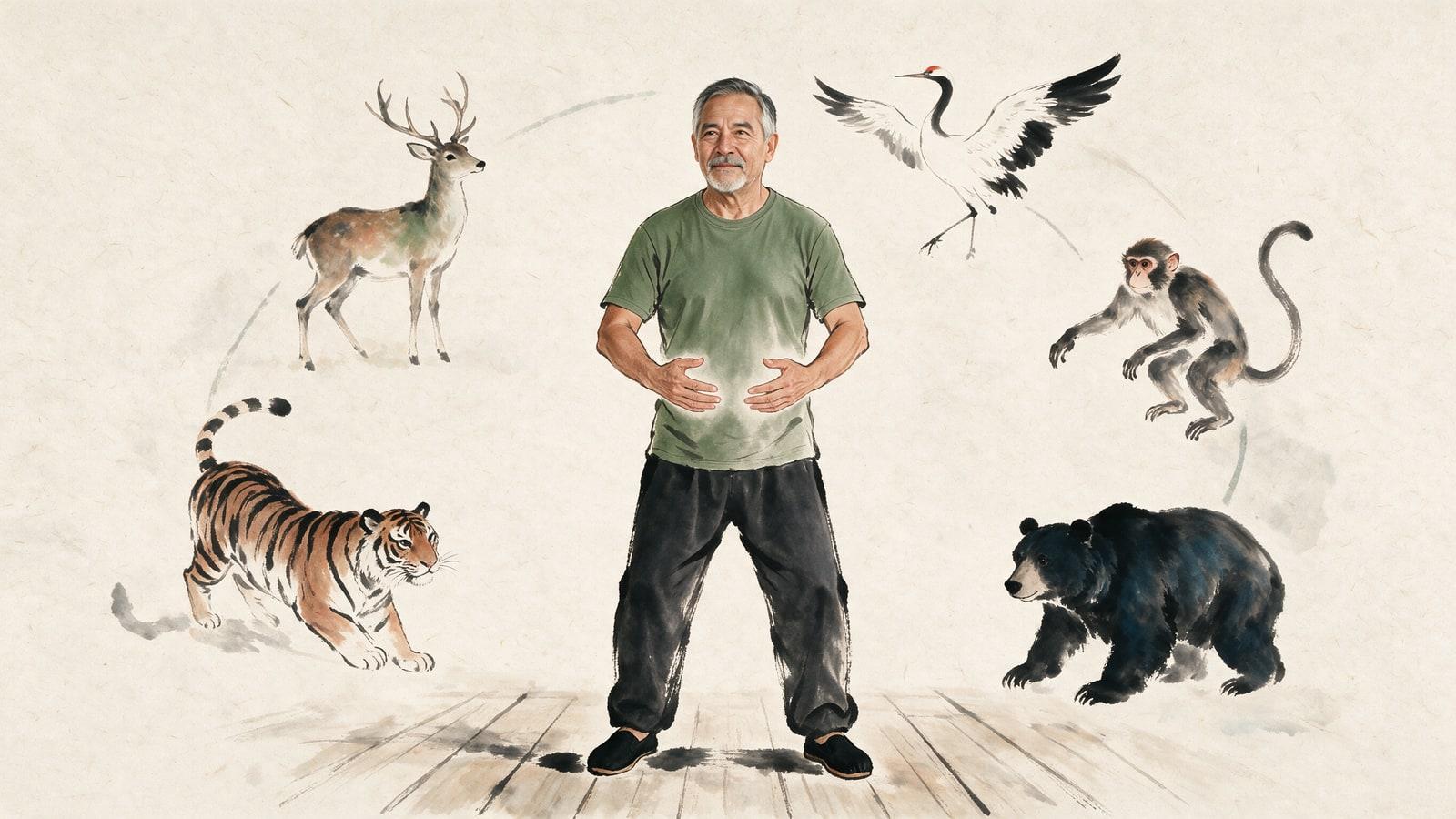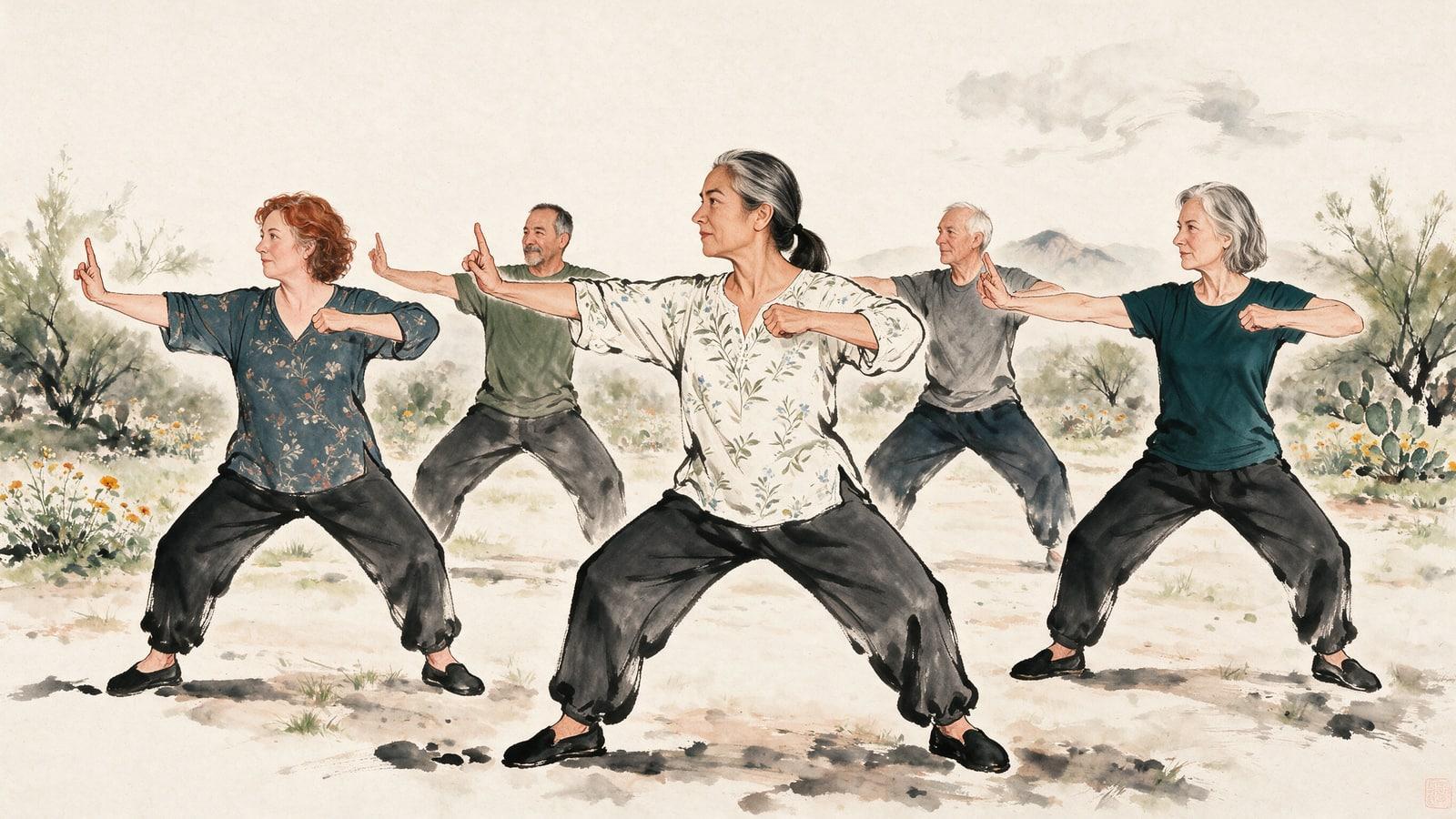

For many new students walking into our Tucson studio, the biggest worry about starting Tai Chi is footwork. It can feel tricky to remember where your feet go next while trying to relax your shoulders at the same time. That is why one of our favorite gateway practices is the 18 Movements of Tai Chi Qigong, widely known as Shibashi.
In this gentle routine, your feet stay comfortably planted at shoulder width for almost the entire sequence. Instead of memorizing winding floor patterns, you repeat each poetic movement six to eight times in a calm, rhythmic loop. Your mind can settle into easy breathing, swaying like bamboo in a warm desert breeze.
☯️ How Tai Chi Flow Met Qigong Simplicity
Created in 1979 by Professor Lin Housheng in Shanghai, Tai Chi Qigong Shibashi (十八式, meaning “Eighteen Movements”) was designed with a clear purpose. He wanted to distill the soft, flowing feeling of Yang Style Tai Chi into a stationary Qigong routine that anyone could enjoy on their very first day.
Each movement rises on a natural inhale and settles on a soft exhale. As your arms float overhead and sweep out to the sides, the gentle rhythm opens your chest, ribs, and shoulders without ever asking you to strain or hold your breath.
“The breath is used as a tool to quiet the mind and to lead energy in and out of the body.”
— Ramel Rones & David Silver, Sunset Tai Chi
🌿 How It Feels in Movement: Five Signature Shibashi Postures
Although the complete first set includes eighteen movements, you only need four or five to experience the soothing rhythm of Shibashi at home:
1. Awakening the Breath (Commencing the Form)
Stand with your feet shoulder-width apart and your knees softly unlocked. Inhale as both arms float up in front of you to shoulder height, as if buoyed by warm water. Exhale as your elbows soften first and your palms drift gently back down past your hips.
2. Opening the Chest to the Morning Air
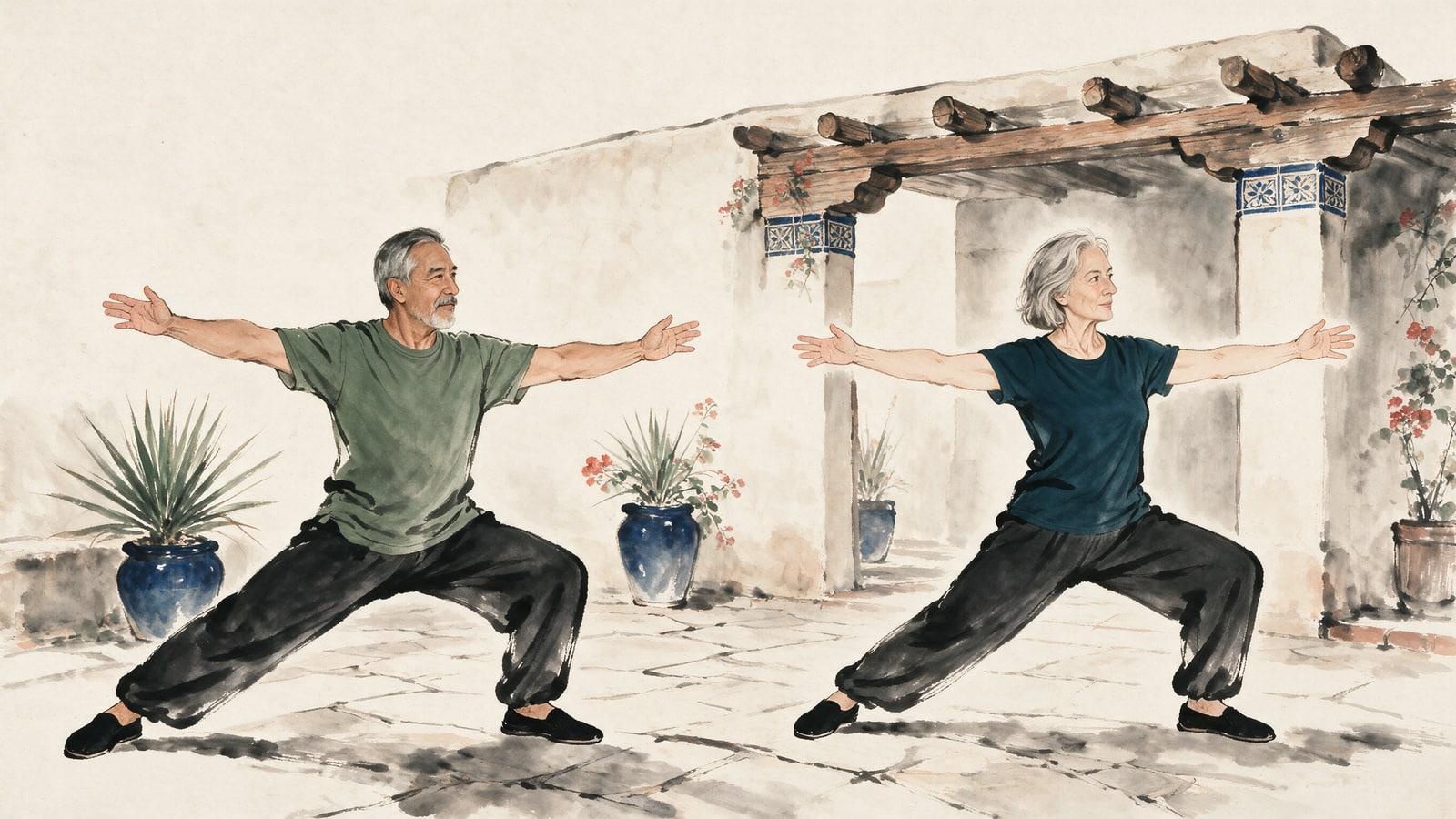
Float both hands up to heart height, then open your arms wide to the sides like opening French doors. Let your collarbone and ribs expand comfortably without arching your lower back. On your exhale, bring your palms softly back toward your center and float them down.
3. Separating the Clouds & Painting a Rainbow Overhead
Cross your wrists softly in front of your belly and lift both arms overhead into a wide, rounded canopy above the crown of your head, as shown in our studio illustration. From this open overhead arch, you can sweep your arms wide to part the clouds or sway gently from hip to hip as if painting a rainbow across the sky.
4. Rowing a Boat on a Quiet Lake
Let both arms circle up overhead and sweep down in front of your body as if dipping two long wooden oars into a calm mountain lake. Fold gently from your hip creases as your hands sweep down, and grow tall through your spine as you draw the oars back up.
5. Wave Hands Like Clouds & Flying Dove Spreads Its Wings
Midway through the set, you turn smoothly from the waist to let your hands drift across the horizon like passing clouds. Next comes Flying Dove Spreads Its Wings, where a gentle forward-and-back weight shift opens your chest as your arms spread wide and gather warmth back toward your heart.
View All 18 Movements of Tai Chi Qigong (Shibashi Set 1)
- Awakening the Breath (Commencing the Form)
- Opening the Chest
- Painting a Rainbow
- Separating the Clouds
- Rolling the Arms in a Calm Breeze (Repulse the Monkey)
- Rowing a Boat on a Quiet Lake
- Lifting the Ball in Front of the Shoulders
- Turning to Gaze at the Moon
- Turning the Waist and Pushing the Palms
- Wave Hands Like Clouds
- Scooping the Sea and Looking at the Sky
- Pushing the Waves
- Flying Dove Spreads Its Wings
- Punching With Softly Extended Arms
- Wild Goose Flying in Place
- Spinning the Wheel
- Bouncing a Ball While Stepping in Place
- Settling the Breath to the Center (Closing the Form)
🥋 Studio Cue: Imagine your wrists are tied to soft silk ribbons floating in water. When your arms rise, let your wrists lead while your fingers trail softly. When your arms sink, let the heels of your palms settle first. This gentle wave melts shoulder tension within two minutes.
🪑 Gentle Adaptation: Because sixteen of the eighteen movements require zero stepping, Shibashi is one of the finest chair Qigong routines ever created. Sit near the front half of a sturdy chair with your feet flat on the floor and let your upper body flow through every movement at a comfortable height.
✨ Key Reflections to Carry With You
- Repetition is where relaxation lives: Repeating each movement six times lets your mind stop worrying about what comes next and simply enjoy the breath.
- Keep overhead reaches comfortable: When lifting your hands above your head in Separating the Clouds or Painting a Rainbow, keep your elbows softly curved and your shoulders relaxed.
- Move from the soles of your feet: Let a gentle rise and settle in your legs initiate the floating of your arms.
Old Pueblo Tai Chi — Traditional Yang & Sun Style Classes
Culture Connects Studio • 3000 E. 22nd Street, Tucson, AZ 85713 • https://oldpueblotaichi.com
Questions about classes? Contact Dan Kimball at dan@oldpueblotaichi.com