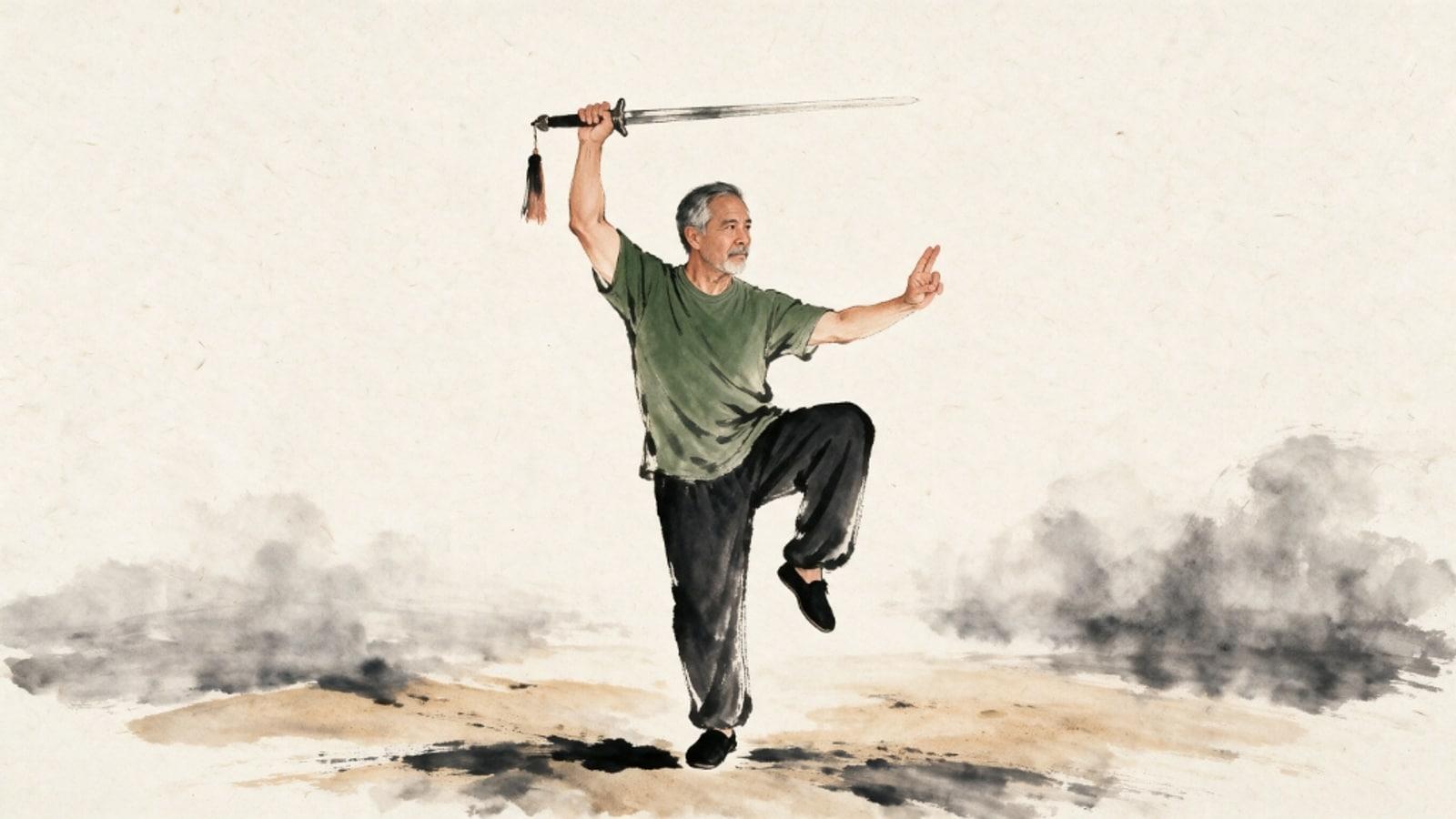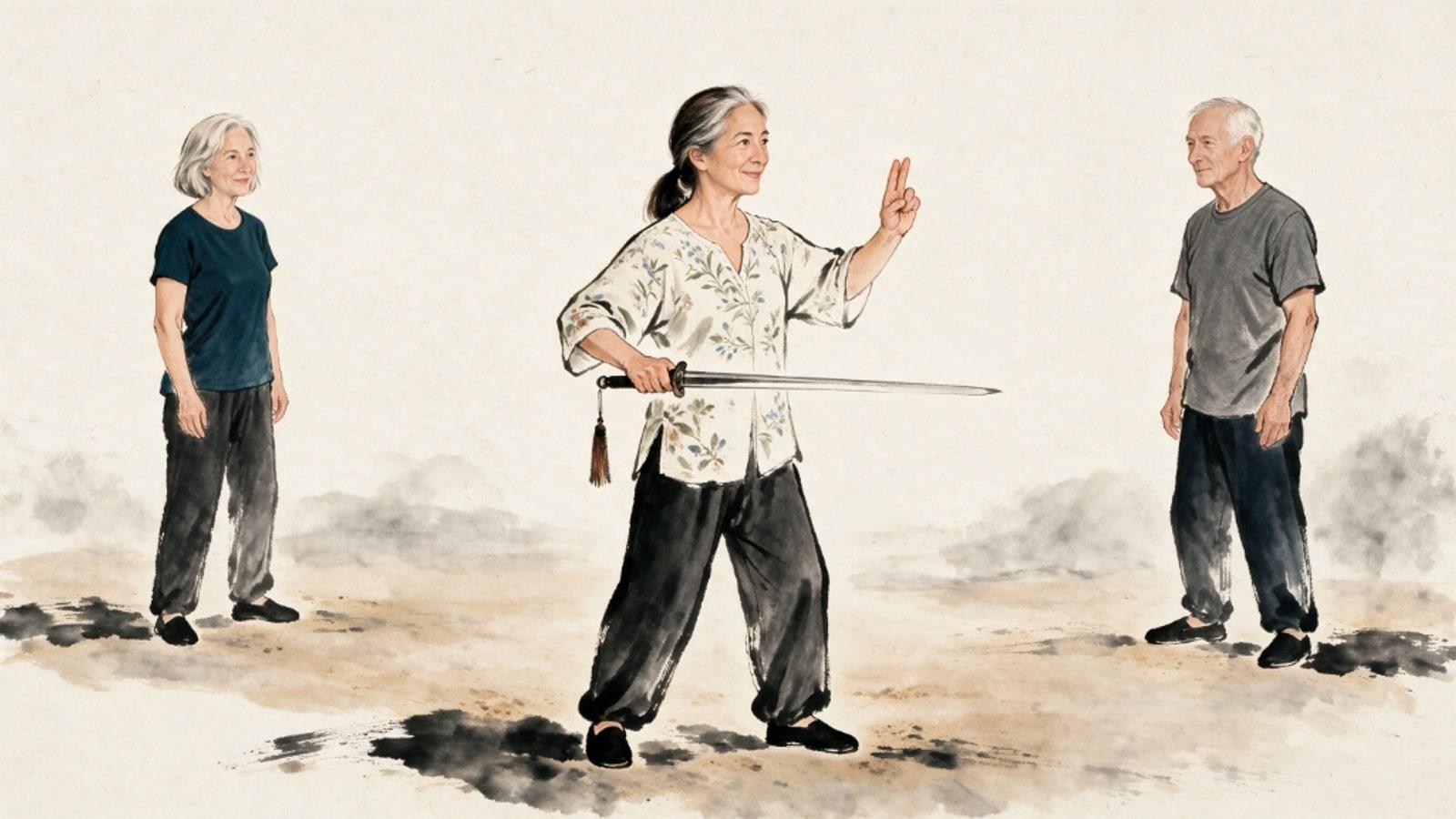

When people watch a Tai Chi Sword demonstration for the first time, their eyes naturally follow the gleaming blade in the right hand. After a moment, though, they almost always notice the left hand—floating upward, curving past the forehead, and reaching out in the opposite direction with two fingers extended.
Why does the free hand move like that? In Tai Chi, we never want one side of the body working while the other side goes to sleep. By giving your opposite hand a clear, graceful role, your two arms work together like the wings of a bird—keeping your spine tall, your chest open, and your balance steady.
☯️ Two Hands Moving as One Conversation
In classical Chinese swordsmanship, the art of handling the blade is called Jianfa (劍法)—literally “the way of the sword.” Rather than swinging the blade like a heavy club, traditional teachers organized sword movement into thirteen gentle, precise actions such as gliding thrusts, upward lifts, soft parries, and figure-eight circles.
“The moment you start to move, your mind becomes the body and the body’s movements become the extension of a calm, flowing, graceful, focused, and centered mind.”
— Dr. Zibin Guo, Adaptive Tai Chi
To balance those subtle movements of the blade, practitioners form a hand shape with the opposite hand called Sword Fingers (Jianzhi 劍指): the index and middle fingers extend softly together while the thumb rests gently over the ring and little fingers. Far from being merely decorative, this simple hand posture gives your upper body a natural rudder for balance.
🌿 How It Feels in Movement: Five Core Actions Anyone Can Try
While traditional manuals list thirteen sword actions in detail, everyday practice really comes down to five friendly, flowing movements that gently exercise your wrists, shoulders, and waist:
1. The Smooth Forward Reach (Thrusting)
As you step into a comfortable forward stance, the sword glides straight ahead at chest height while your opposite hand reaches softly backward. Stretching in two directions at once creates a wonderful feeling of length across your collarbones and upper back.
2. The Dragonfly Tap (Pointing)
With a soft lift of the wrist, the very tip of the blade dips downward for a split second—just like a dragonfly touching a quiet pond—before floating back up. This gentle motion loosens stiff wrists without any heavy load.
3. Rising and Sweeping Circles (Lifting & Carrying)
Guided by a slow turn of your waist, the blade sweeps in smooth upward and downward arcs in front of your body, encouraging tight shoulders to oil and move freely within a comfortable range.
4. The Figure-Eight Spiral (Tassel Circles)
By turning your waist left and right while your wrist stays supple, the sword traces a horizontal figure-eight in the air. If your sword has a tassel, watching the tassel swing smoothly without tangling tells you that your movement is unhurried and even.
5. Reuniting the Hands (Closing & Cradling)
Between movements, your free hand often arcs in to meet your sword wrist before the two hands open apart again—training smooth hand-eye coordination and calm breathing.
🥋 Studio Cue: Try forming “Sword Fingers” right now with both hands: extend your index and middle fingers together without stiffening them, and rest your thumb lightly on your ring finger. Open both arms wide as you inhale, then bring them together in front of your chest as you exhale.
🪑 Gentle Adaptation: You don’t even need a sword to enjoy this coordination drill. Sitting tall in a chair, hold a wooden chopstick or pen in one hand and form Sword Fingers with the other, practicing slow, mirrored circles as you breathe.
✨ Key Reflections to Carry With You
- Both sides of the body stay awake: Pairing the sword hand with Sword Fingers turns every movement into balanced, whole-body coordination.
- Wrist mobility without strain: Small, unhurried arcs gently exercise the hands, wrists, and forearms.
- Move from your waist, not your shoulders: Let your torso turn first and allow your arms to follow like ribbons in a breeze.
Old Pueblo Tai Chi — Traditional Yang & Sun Style Classes
Culture Connects Studio • 3000 E. 22nd Street, Tucson, AZ 85713 • https://oldpueblotaichi.com
Questions about classes? Contact Dan Kimball at dan@oldpueblotaichi.com