
In modern life, we are taught that the best way to solve any problem is to push harder, move faster, and use more willpower. Yet when you bring that habit onto the Tai Chi floor, you quickly notice something funny. Trying to force yourself to balance or gripping your muscles to stay steady actually makes you wobble more.
Classical Tai Chi invites us to try a completely different approach inspired by how water flows down a canyon stream. Instead of muscling through every posture, we learn the art of unforced, natural movement.
☯️ The Wisdom of Water
In Chinese philosophy, this effortless quality is called Wu Wei (無為). People sometimes translate it as “doing nothing,” which makes it sound like sitting on the porch all day. As the philosopher Alan Watts explained in his book Tao: The Watercourse Way, a much better translation is “not forcing”: moving with the grain of nature rather than against it.
“Nothing in the world is softer and more yielding than water, yet for overcoming the hard and strong, nothing can surpass it.”
— Laozi, Tao Te Ching (Chapter 78)
Watch water flowing through Sabino Canyon after a desert rain. When a stream meets a boulder, it does not stop and argue with the rock, nor does it turn back. It simply curves around the obstacle and keeps flowing downhill. In Tai Chi, we practice moving our bodies with that same calm adaptability.
🌿 How It Feels in Movement: Three Ways to Practice “Not Forcing”
1. Let Your Wrists Float as Gravity Grounds Your Feet
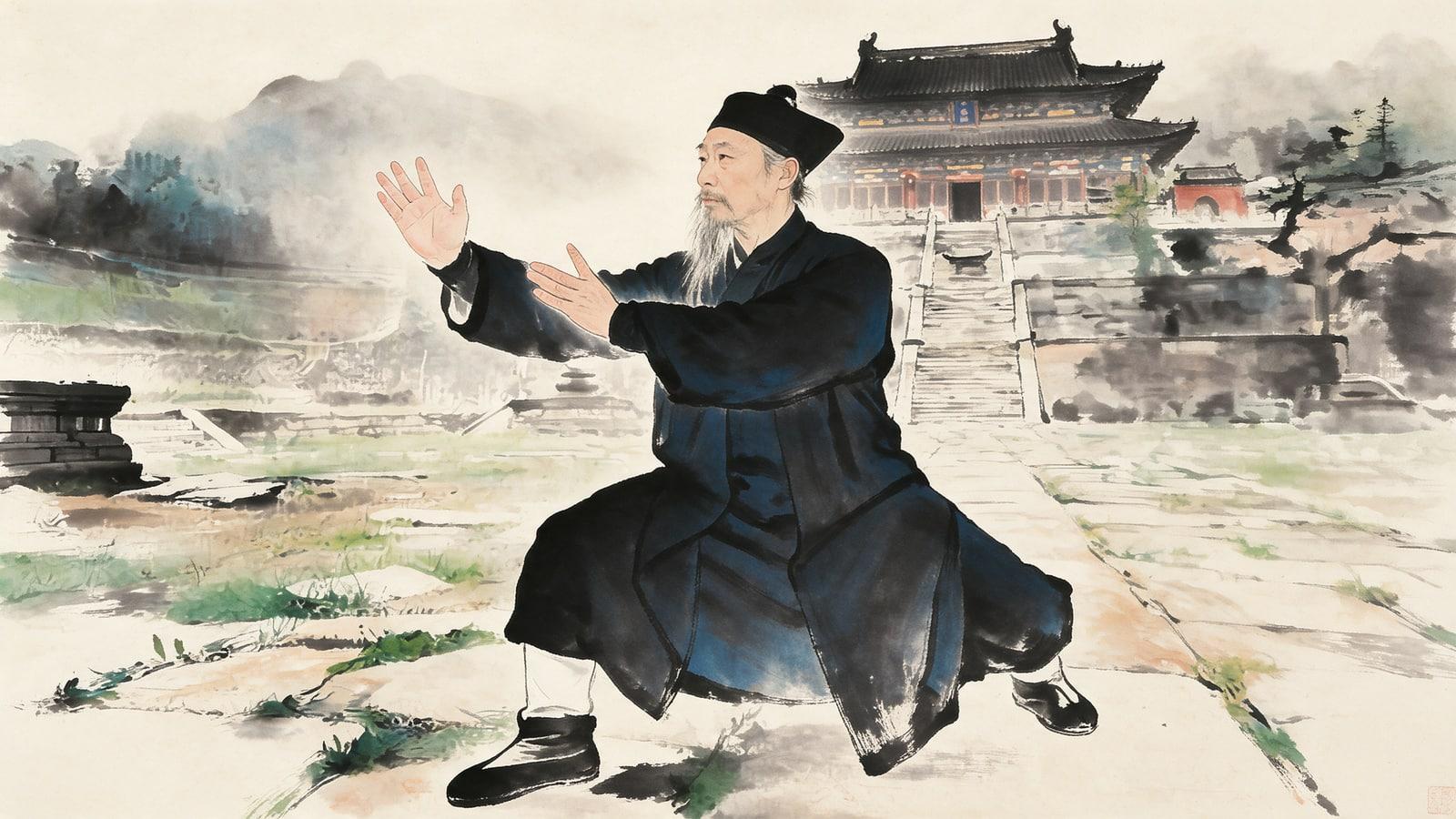
Instead of lifting your arms with tight neck and shoulder muscles, let your weight settle down through your hips and knees into your feet. As shown in our courtyard illustration, when your base settles like water seeking low ground, your wrists and hands float upward with almost zero effort.
2. Smooth Out the Corners Between Movements
In most exercises, you start a movement, stop abruptly, and start the next one. In Tai Chi, the end of one posture flows directly into the beginning of the next, like gentle waves rolling onto the shore without a sharp stop.
3. Practice the “70-Percent Rule”
Whether you are stepping, turning your waist, or raising your arms, move within roughly 70 percent of your comfortable range. Leaving that extra 30 percent of breathing room keeps your joints soft and your mind unhurried.
🥋 Studio Cue: Next time you lift your arms in the opening posture of Tai Chi, imagine your wrists are resting on top of a rising tide. Let them float upward on your inhale and settle softly downward as the tide recedes on your exhale.
🪑 Gentle Adaptation: You can bring this watercourse feeling into everyday errands. Next time you are stuck at a long red light on Broadway or waiting in a checkout line, let your shoulders drop half an inch and take three slow breaths.
✨ Key Reflections to Carry With You
- Not forcing is not laziness: Moving without extra tension lets you stay active longer with far less fatigue.
- Curve around stiffness: If a joint feels tight today, soften your stance and take a gentler path rather than pushing through discomfort.
- Carry the calm home with you: The unhurried rhythm you practice in class makes everyday stress much easier to navigate.
Old Pueblo Tai Chi — Traditional Yang & Sun Style Classes
Culture Connects Studio • 3000 E. 22nd Street, Tucson, AZ 85713 • https://oldpueblotaichi.com
Questions about classes? Contact Dan Kimball at dan@oldpueblotaichi.com