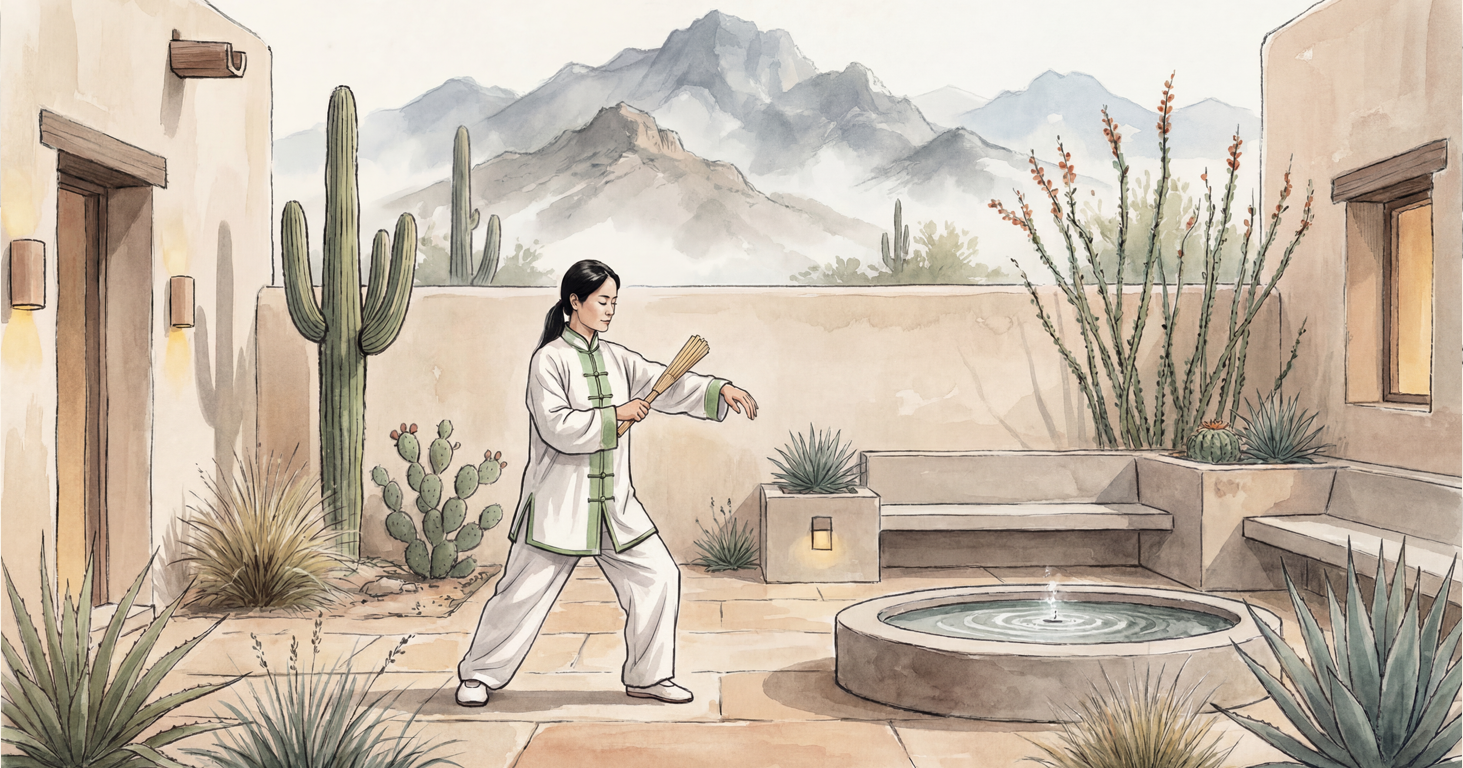
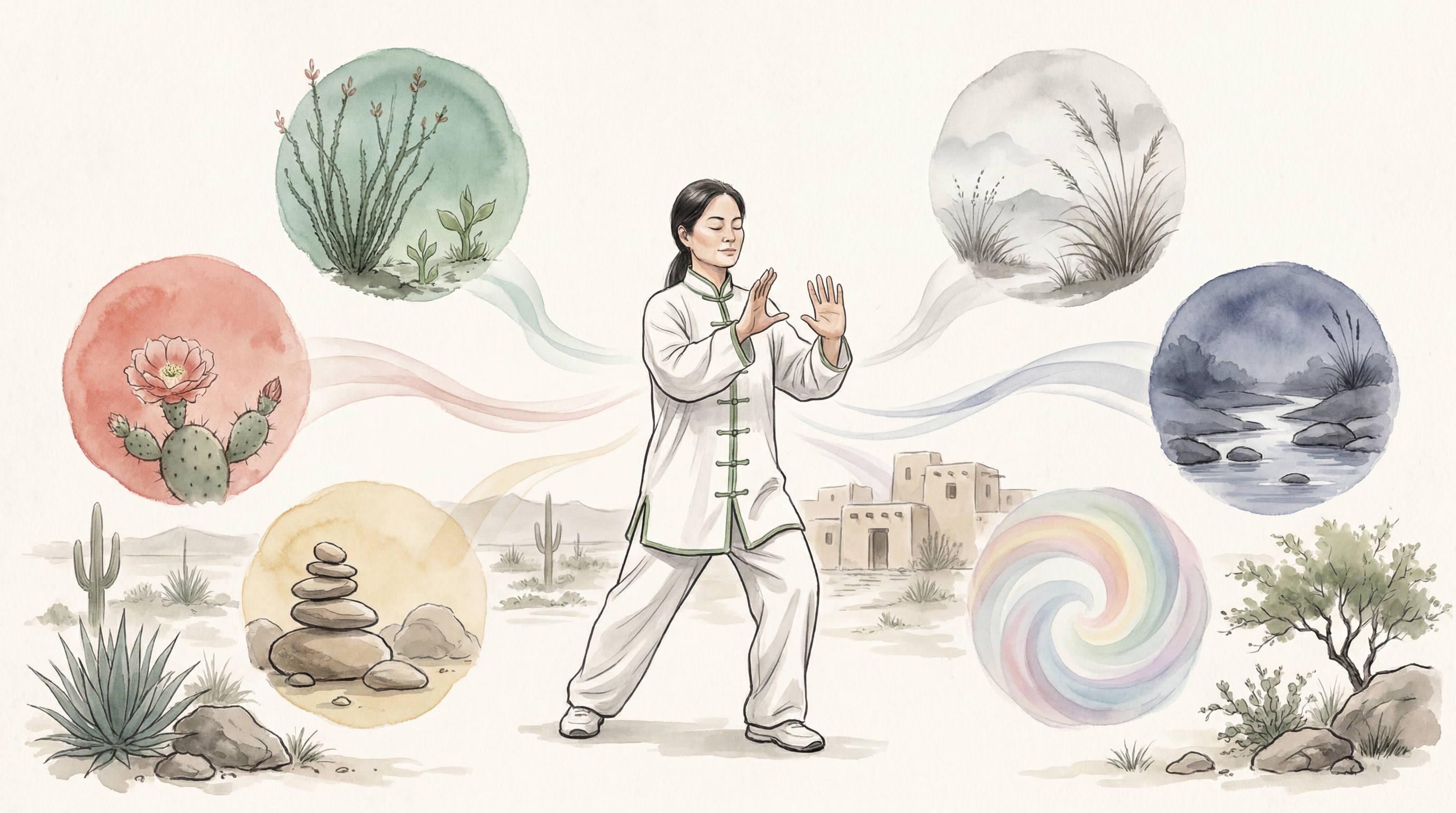
If you are new to Qigong, the Six Healing Sounds are a great place to begin. This gentle practice does not require special equipment, athletic ability, or years of experience. You breathe in comfortably, exhale with a soft sound, and move slowly enough to stay relaxed and aware.
It’s a simple sequence of six soft exhale-sounds paired with relaxed breathing and gentle movement.
Known traditionally as Liu Zi Jue, the Six Healing Sounds have been practiced for generations and are often used as a way to support calm, release everyday tension, and reconnect with the natural rhythm of the breath. At Old Pueblo Tai Chi, we teach this practice in a simple, grounded way so beginners can experience Qigong as practical and accessible from the very first class.
Quick Answer
The Six Healing Sounds, also known as Liu Zi Jue, are a gentle Qigong practice that combines breathing, soft vocal sounds, simple movement, and mindful attention.
In Traditional Chinese Medicine, each sound is traditionally associated with an organ system and suggests an emotional theme. You can treat these associations as a symbolic and practical map for self-awareness, not a medical claim. We teach the Six Healing Sounds as a calm wellness practice. It is not a medical treatment, but many people find it supports relaxation and pairs well with Tai Chi, meditation, and everyday self-care.
What Are the Six Healing Sounds?
The Six Healing Sounds are a traditional Chinese Qigong practice, sometimes called Six Healing Sounds Qigong (Liu Zi Jue). The Chinese name, Liu Zi Jue, means “Six Character Formula.” Each “character” refers to a sound made gently on the exhale.
The six sounds are commonly taught as:
- Xu — Liver
- He — Heart
- Hu — Spleen/Stomach
- Si — Lungs
- Chui — Kidneys
- Xi — Triple Burner
You do not need to understand Chinese medicine to begin. You also do not need to pronounce everything perfectly. The most important part is simple:
Breathe gently, relax your body, make the sound softly, and notice how you feel.
Why Use Sound in Qigong?
Sound gives the breath a shape. When we sigh, hum, chant, whisper, or exhale slowly, many people notice the body starts to settle. The Six Healing Sounds use that natural calming effect in a more intentional way. (If you’re curious how this kind of attention training fits into movement practice, see How Mindfulness Enhances Tai Chi.)
The sounds can help you:
- Slow your breathing
- Relax your face, jaw, throat, and chest
- Focus your attention
- May help soften emotional tension
- Connect breath with gentle movement
- Create a simple daily calming ritual
For many beginners, the sounds make Qigong feel less abstract. Instead of trying to “clear the mind,” you have one simple thing to do: breathe in, exhale with the sound, and soften.
Dr Jun Wang performing the 6 Healing Sounds Qigong
Cultivating Qi: An Introduction to Chinese Body-Mind Energetics

A Short History of Liu Zi Jue
The Six Healing Sounds are part of ancient Chinese traditions of health cultivation, often connected with Daoist practice and Traditional Chinese Medicine. The practice is also known as Liu Zi Jue, which is commonly translated as the “Six Character Formula” or “Six Healing Sounds.”
The history of Liu Zi Jue is sometimes associated with Tao Hongjing, a Daoist instructor, physician, scholar, and writer from the 5th and 6th centuries. Over time, the practice was preserved and adapted through different Qigong lineages.
That is why you may hear slightly different pronunciations, movements, or explanations depending on the instructor.
For a beginner, this is not a problem. The heart of the practice remains the same: gentle breath, relaxed movement, mindful awareness, and emotional balance.
The Six Healing Sounds at a Glance
Sound | Organ System | Element | Emotion Traditionally Released | Quality Invited |
Xu | Liver / Gallbladder | Wood | Anger, frustration | Kindness, flexibility |
He | Heart / Small Intestine | Fire | Agitation, impatience | Joy, love, peace |
Hu | Spleen / Stomach | Earth | Worry, overthinking | Stability, trust |
Si | Lungs / Large Intestine | Metal | Grief, sadness | Courage, acceptance |
Chui | Kidneys / Bladder | Water | Fear, insecurity | Wisdom, resilience |
Xi | Triple Burner / San Jiao | Whole-body regulation | Scattered stress | Harmony, integration |
These associations come from Traditional Chinese Medicine. They are best approached as a symbolic and practical map for self-awareness, not as a rigid medical formula.
The Six Sounds Explained for Beginners
1. Xu — Liver Sound
Pronunciation: Soft “shhh” or “shü”
Associated emotion: Anger, frustration, feeling stuck
Quality invited: Kindness, calm, flexibility
The Liver sound is often used when you feel tense, irritated, or emotionally rigid.
As you exhale with Xu, imagine the sides of the body softening. Let the ribs, jaw, eyes, and shoulders release.
2. He — Heart Sound
Pronunciation: Gentle “huh,” “heh,” or “haa”
Associated emotion: Agitation, impatience, overexcitement
Quality invited: Joy, love, peace
The Heart sound is helpful when the mind feels busy or the emotions feel heated.
As you exhale with He, soften the chest, tongue, face, and hands. Let the breath cool and settle the body.
3. Hu — Spleen/Stomach Sound
Pronunciation: “Hoo” or “whooo”
Associated emotion: Worry, rumination, overthinking
Quality invited: Groundedness, trust, stability
The Spleen/Stomach sound is often used when the mind keeps circling around the same concern.
As you exhale with Hu, bring awareness to the belly. Imagine the breath smoothing out nervous knots and returning you to center.
4. Si — Lung Sound
Pronunciation: Soft “sss”
Associated emotion: Grief, sadness, heaviness
Quality invited: Courage, acceptance, clarity
The Lung sound is connected with letting go.
As you exhale with Si, imagine the chest becoming more spacious. Let the breath release what the body no longer needs to hold.
5. Chui — Kidney Sound
Pronunciation: “Chway,” “chwee,” or “choo-ee”
Associated emotion: Fear, insecurity, depletion
Quality invited: Wisdom, resilience, quiet strength
The Kidney sound is often practiced when you feel tired, fearful, or uncertain.
As you exhale with Chui, soften the lower back, hips, knees, and lower belly. Let the breath settle downward.
6. Xi — Triple Burner Sound
Pronunciation: “Shee,” “see,” or soft “hee”
Associated emotion: Scattered stress, disconnection
Quality invited: Harmony, integration, relaxation
The Triple Burner, also called the San Jiao or Triple Warmer, is not a single physical organ. In Traditional Chinese Medicine, it refers to the coordination of the upper, middle, and lower areas of the body.
The Xi sound is often practiced at the end of the sequence to bring everything together.
As you exhale with Xi, imagine the whole body settling into one connected rhythm.
How to Practice the Six Healing Sounds
If you are brand new, keep it simple:
- Find a comfortable posture (seated or standing) and let the shoulders drop.
- Inhale gently through the nose.
- Exhale slowly and make the sound softly (no pushing or strain).
- Add a small, relaxed movement if you like, but keep it easy.
- Do 3–6 rounds of one sound, or one round of all six.
- Finish with a few quiet breaths and notice how you feel.
Do the Sounds Need to Be Loud?
No. In fact, softer is usually better. The sound should feel like a gentle vibration riding on the breath. You should not strain the throat, tighten the jaw, or push the air out.
Over time, some practitioners make the sounds very quietly or even internally. For beginners, a soft audible sound is a helpful place to begin.
Common Beginner Mistakes
When learning the Six Healing Sounds, keep the practice simple. A few common beginner mistakes include:
- Trying too hard: The sounds should be soft and easy, not forced or dramatic.
- Making the breath too long: Let the exhale be comfortable. Do not strain to empty the lungs.
- Worrying about perfect pronunciation: Different instructors use slightly different sounds. Relaxation and awareness matter more than perfection.
- Skipping the transition and closing pause: Take a few quiet breaths at the end of each so the body has time to settle.
Safety Tips
The Six Healing Sounds should feel comfortable and calming.
Please keep these guidelines in mind:
- Do not force the breath.
- Do not hold your breath.
- Do not shout the sounds.
- Do not strain your throat.
- Do not make the exhale too long.
- Stop if you feel dizzy, anxious, lightheaded, or fatigued.
- Practice gently and consistently rather than intensely.
Frequently Asked Questions
Do I need experience with Tai Chi or Qigong?
No. The Six Healing Sounds are beginner-friendly. You can start with seated practice and simple breathing.
Do I have to understand Chinese medicine?
No. The traditional associations can make the practice more meaningful, but you can still benefit from slowing down, breathing gently, and relaxing the body.
Can I practice only one sound?
Yes. You can practice the full sequence or choose one sound that feels helpful that day.
For example, you might choose:
- Xu when you feel tense, frustrated, or “stuck”
- He when you feel agitated or emotionally heated
- Hu when you feel worried
- Si when you need to let go
- Chui when you feel fearful or depleted
- Xi when you want to relax before rest
How often should I practice?
Start with 3 to 5 minutes a few times per week.
Consistency matters more than duration.
When is the best time to practice?
Many people enjoy practicing in the morning to begin the day calmly or in the evening to unwind. You can also use one or two sounds during a stressful moment.
Learning the Six Healing Sounds at Old Pueblo Tai Chi
At Old Pueblo Tai Chi, we teach Qigong in a gentle, practical, and beginner-friendly way. The Six Healing Sounds are a helpful practice for students who want to:
- Build a calmer relationship with the breath
- Reduce everyday stress
- Add mindfulness to Tai Chi
- Learn gentle movement in a supportive setting
- Explore traditional practices in a grounded way
A Warm Tucson Invitation
If you are in Tucson and you would like a supportive, beginner-friendly way to learn Qigong and Tai Chi, we would love to practice with you!
- Learn more about beginner Tai Chi classes in Tucson: /
- Explore Qigong classes: /qigong-classes-tucson
- View the class schedule: /schedule
Bridging Theory to Practice
Try This Today: The Calming Triple Burner 'Xi' Exhale
2 minutes
Somatic Intent: Direct smooth downward warmth from your chest through your solar plexus to your feet.
- 1Stand tall and float both hands upward to chest level, palms facing the body.
- 2Turn palms downward and press gently toward the floor while whispering the sound 'Xiiii' (like 'sheee').
- 3Feel heat and mental pressure cascading down the body and dissolving harmlessly into the earth.
- 4Pause in stillness for one breath, then repeat 3 times.
* Always work within your personal comfort zone. There is never any forcing, straining, or breath-holding in Tai Chi.
Old Pueblo Tai Chi — Traditional Yang & Sun Style Classes
Culture Connects Studio • 3000 E. 22nd Street, Tucson, AZ 85713 • https://oldpueblotaichi.com
Questions about classes? Contact Dan Kimball at dan@oldpueblotaichi.com or (520) 222-8232
Practice Newsletter
Stay Connected with Old Pueblo Tai Chi
Get new articles, practical movement guides, seasonal health insights, and Tucson class announcements delivered to your inbox.
Experience the Practice in Person
Reading about Tai Chi is great, but the true benefits come from moving. Join our welcoming morning classes at Culture Connects Studio in Midtown Tucson.
Culture Connects Studio • 3000 E 22nd St, Tucson, AZ 85713 • Mondays & Wednesdays 10:00 AM – 11:00 AM (Doors open 9:45 AM, arrive 10–15 min early)