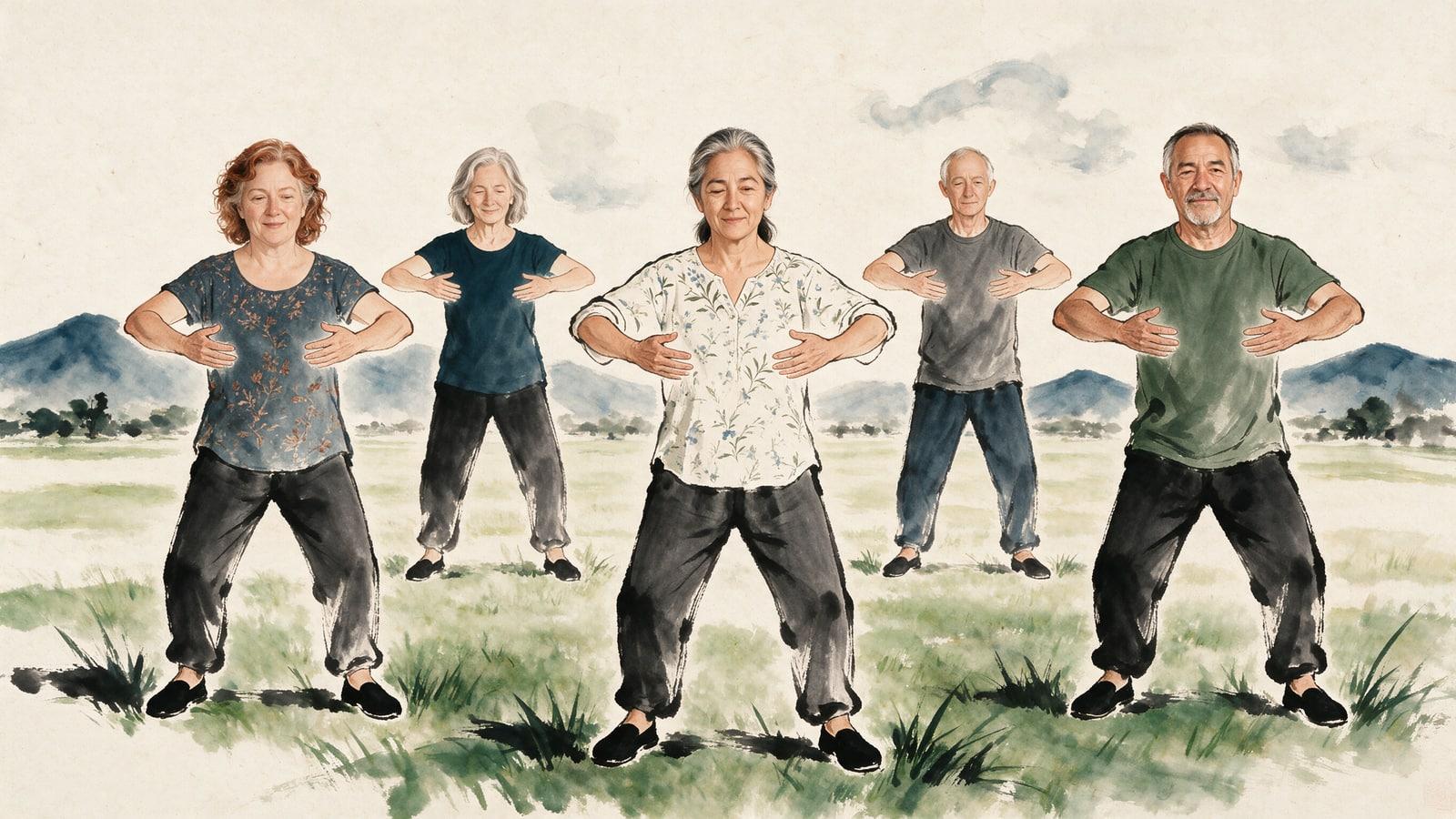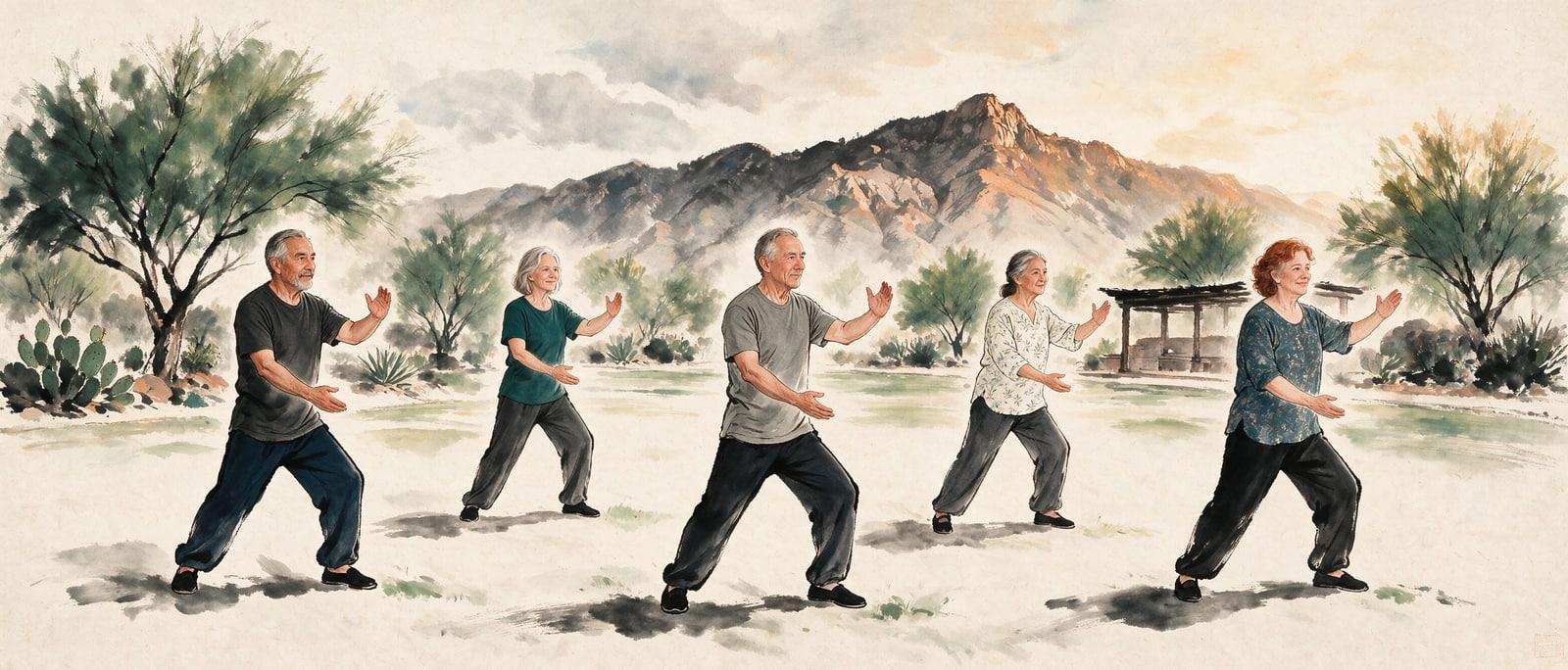

Today, you can spot people practicing Tai Chi in neighborhood parks, hospital wellness programs, and community studios from coast to coast, including right here in Tucson. Yet just seventy years ago, almost no one in the United States had ever heard the words Tai Chi.
How did a centuries-old Chinese family art travel across the Pacific to become one of America’s most loved practices for balance and peace of mind? The story belongs to a handful of generous pioneers who believed that Tai Chi was too valuable to keep behind closed doors.
☯️ From Private Courtyards to Public Parks
For generations in China, Tai Chi (Taiji 太極) was passed down quietly inside family courtyards. In the early twentieth century, visionary teachers realized that calm breathing and gentle balance could improve the health of everyday citizens of all ages. Soon, four pioneering teachers carried that open spirit to North America:
“T’ai Chi Ch’uan, the great ultimate, strengthens the weak, raises the sick, invigorates the debilitated, and encourages the timid.”
— Professor Cheng Man-ch’ing, T’ai Chi Ch’uan: A Simplified Method of Calisthenics for Health & Self-Defense
- Choy Hok Pang and Choy Kam Man (San Francisco, 1939): Just before World War II, master teacher Choy Hok Pang and his son began teaching traditional Yang-style Tai Chi openly in San Francisco’s Chinatown.
- Sophia Delza (New York City, 1954): American modern dancer Sophia Delza studied in Shanghai under Master Ma Yueliang and returned to New York to give the first public demonstrations at the Museum of Modern Art and the United Nations. In 1961, she wrote Body and Mind in Harmony, the first English-language book on Tai Chi.
- Professor Cheng Man-ch’ing (New York City, 1964): A painter, poet, physician, and Tai Chi master, Professor Cheng distilled the long traditional routine into an accessible 37-posture form that busy adults could learn in months rather than years.
- Grandmaster Bow Sim Mark (Boston, 1970s): Founder of the Chinese Wushu Research Institute in Boston, Madame Bow Sim Mark introduced generations of Americans to the flowing grace, musicality, and expressive sword work of Wudang and combined Tai Chi forms.
🌿 How It Feels in Movement: Three Gifts Those Pioneers Left Us
1. Open Doors for Every Age and Background
Before these pioneers, traditional training often required grueling athletic conditioning. They showed that anyone who can breathe and shift weight gently can enjoy the lifelong health benefits of Tai Chi.
2. Softness and Grace Over Muscular Force
Whether in Professor Cheng’s relaxed empty-hand posture or Madame Bow Sim Mark’s flowing Wudang sword routines, every pioneer taught that letting go of stiffness is the true heart of the art.
3. Practical Routines for Daily Life
By creating clear, approachable forms, these teachers made it easy to practice for ten or fifteen quiet minutes in a living room, courtyard, or neighborhood park.
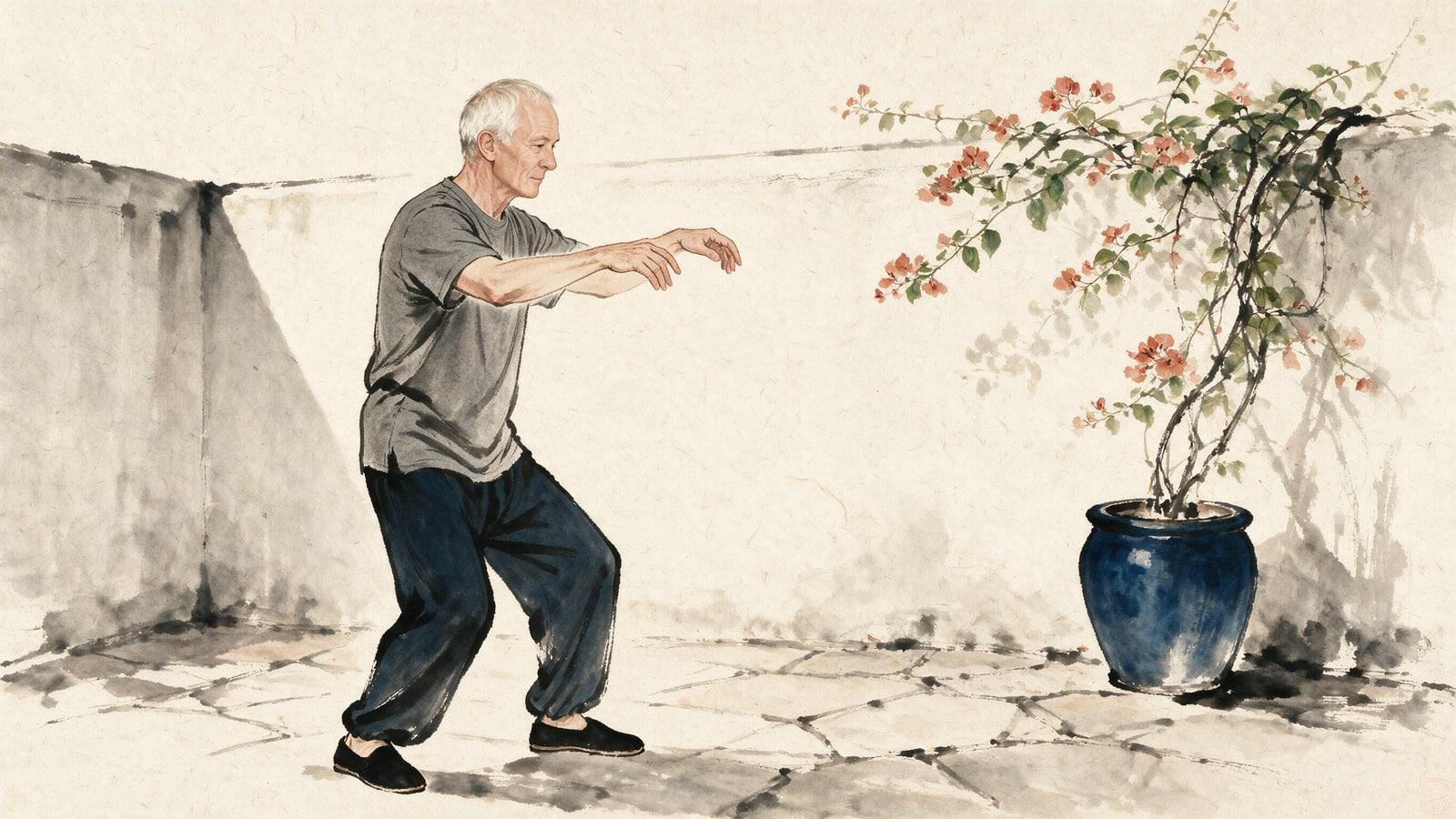
🥋 Studio Cue: Try Professor Cheng’s favorite everyday check. Let your hands float up as if your wrists are resting on soft pillows, keeping your fingers relaxed, unhurried, and free of tension.
🪑 Gentle Adaptation: Sophia Delza often taught Tai Chi to actors, seniors, and office workers right beside their chairs. Even a single slow, attentive weight shift or arm circle refreshes the whole body without requiring deep stances.
✨ Key Reflections to Carry With You
- A living bridge between cultures: Every time we practice in Tucson, we step into a welcoming tradition shared across generations.
- Simplicity is a strength: You only need a few comfortable feet of floor space and ten quiet minutes to practice.
- Community keeps the art alive: Practicing together in person is the best way to learn and enjoy the journey.
Old Pueblo Tai Chi — Traditional Yang & Sun Style Classes
Culture Connects Studio • 3000 E. 22nd Street, Tucson, AZ 85713 • https://oldpueblotaichi.com
Questions about classes? Contact Dan Kimball at dan@oldpueblotaichi.com