About 1,800 years ago, a Chinese doctor named Hua Tuo (around 140–208 CE) created one of the world's first exercise programs designed to keep people healthy. It's called Wu Qin Xi (五禽戏), or the Five Animal Frolics.
Hua Tuo noticed something about wild animals. They stay strong and flexible their whole lives without gyms or workout plans. They just move naturally: they stretch, twist, crouch, leap, and balance.
He took ideas from even older Chinese exercises and built a routine based on how five animals move:
- Tiger
- Deer
- Bear
- Monkey
- Bird (Crane)
An old Chinese saying sums up the idea: “Flowing water never goes stale, and a door hinge that keeps moving never rots.” In other words, a body that keeps moving stays healthy.
According to the History of the Later Han Dynasty, Hua Tuo's student Wu Pu practiced this routine regularly. Records say he still had good eyesight, sharp hearing, and plenty of energy in his nineties.
Watch the Practice
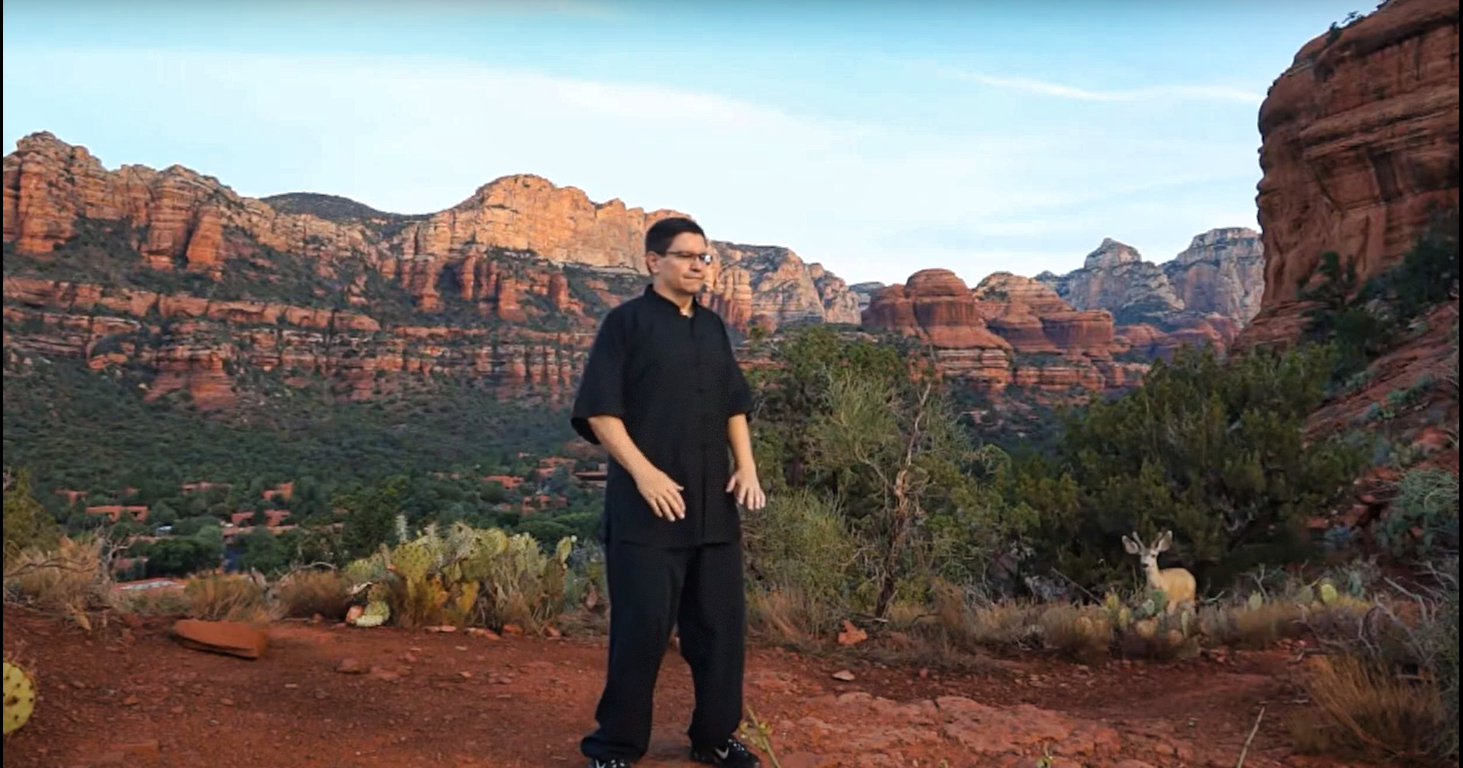
To see how the five animals move, follow along with our practice session, filmed among the red rocks of Sedona, Arizona:
Watch the Video: Five Animal Frolics Qigong — Wu Qin Xi at Boynton Canyon (Old Pueblo Tai Chi)
Why Moving Like an Animal Helps
Modern life keeps our bodies in a few fixed positions. We sit in chairs, walk on flat ground, and often work out using machines that move in only one direction. Over time this can lead to:
- A stiff upper back
- Tight hips
- Poor balance
- Muscles that “forget” how to support us
The Five Animal Frolics helps undo this. Here's how:
1. Your whole body works together.
Instead of working one muscle at a time, each movement flows from your feet, through your hips and spine, out to your fingertips.
2. Your spine gets moving again.
Bending forward, arching back, leaning sideways, and twisting all help keep your spine flexible. They also ease the pressure that builds up from sitting too long.
3. You calm your stress response.
Slow, deep belly breathing combined with gentle movement helps your body relax. This can lower stress and support heart health.
4. Your balance gets better.
Shifting your weight, turning, and standing on one leg train your body's balance system. This is especially helpful for older adults, because good balance helps prevent falls.
The Order of the Animals
In traditional Chinese medicine, each animal is linked to a natural element, a direction, and certain organs. Hua Tuo's traditional order is:
Tiger → Deer → Bear → Monkey → Crane
Why this order? The sequence balances your energy. It begins with the strong, active Tiger, moves into the calm Deer, settles into the steady Bear, lifts into the lively Monkey, and finishes with the deep breathing of the Crane.
The Five Animals: What They Do and How to Practice
Safety first: Move slowly and stay within a comfortable range. Never push into pain. If your balance is unsteady, stand near a wall or hold the back of a sturdy chair. Many movements can also be done seated. If you have a health condition, check with your doctor before starting.
1. The Tiger — Strength and Focus
Good for: Back strength, grip strength, and posture
Mental benefit: Sharpens focus and helps release frustration
The Tiger moves with slow, powerful intent. You bend your knees, curl and stretch your spine, and make your hands into “tiger claws”: fingers spread and curled, like you're gripping something.
How to do it:
- Stand with your feet wider than your hips and your knees slightly bent. Keep your knees in line with your toes.
- Breathe in: Bring your hands, shaped like claws, up to your ribs. Let your back round slightly.
- Breathe out: Push your hands forward as if reaching out. Open your chest, look ahead, and keep your shoulders relaxed and down.
Easier version: Do the arm movements while seated.
2. The Deer — Twisting for a Healthy Spine
Good for: Lower back, waist, and spinal flexibility
Mental benefit: Builds calm alertness and helps ease fear and nervousness
The Deer is about gentle, graceful twisting. Your hands make “deer antlers”: thumb, index finger, and pinky stretched out, with the middle and ring fingers folded down.
How to do it:
- Step one foot forward and gently shift your weight onto it.
- Reach your back hand behind you in the antler shape.
- Slowly turn your upper body and look back over your shoulder.
- Return to center and switch sides.
Tip: The twist should come from your waist and upper back, not your knees. Keep your knees pointing forward.
3. The Bear — Steady and Grounded
Good for: Core strength, hips, and digestion
Mental benefit: Calms an overactive mind and helps stop overthinking
The Bear is slow, heavy, and relaxed. You gently sway and circle your body, which also massages your belly and digestive organs.
How to do it:
- Stand with feet shoulder-width apart. Let your arms hang loose and heavy.
- Slowly shift your weight to your right foot, letting your right shoulder roll slightly forward and down.
- Circle your upper body across to the left, shifting your weight to your left foot.
- Continue slow, smooth circles. Feel relaxed and heavy, like a bear.
Easier version: Do the circles while seated, rocking gently side to side.
4. The Monkey — Quick and Lively
Good for: Ankles, calves, reaction time, and eye-body coordination
Mental benefit: Clears mental fog and lifts your mood
The Monkey is playful and alert. It trains quick reactions, which matters for catching yourself if you trip.
How to do it:
- Stand with your feet close together.
- Rise up onto the balls of your feet and pull your hands in toward your chest. Pinch your fingertips together like a hook.
- Quickly turn your head to look over one shoulder, like a curious monkey.
- Lower your heels back down and repeat on the other side.
Easier version: Hold a chair for support, and rise only slightly onto your toes. Turn your head gently instead of quickly.
5. The Crane — Deep Breathing and Balance
Good for: Opening the chest, shoulders, breathing, and one-leg balance
Mental benefit: Brings a feeling of freedom and helps ease sadness
The Crane opens your chest and fills your lungs. You lift your arms like wings while balancing on one leg.
How to do it:
- Stand tall.
- Breathe in slowly: Raise both arms out to the sides and up, like wings. At the same time, lift one knee toward hip height. Keep your standing knee slightly bent, not locked.
- Breathe out slowly: Lower your arms and set your foot down quietly and gently.
- Repeat on the other side.
Easier version: Keep your toes lightly touching the floor, or hold a chair with one hand.
Quick Summary Chart
How to Add the Five Animals to Your Day
You don't need to learn a long routine to benefit. Here are some simple ways to start:
Short movement breaks: Pick one animal that fits how you feel.
- Been sitting a long time? Try the Deer for your lower back.
- Feeling hunched over? Try the Crane to open your chest.
- Feeling scattered or stressed? Try the Bear to settle down.
Warm-up or cool-down: Do all five animals in order, about 2–3 minutes each. This works well before walking, exercising, or gardening.
Let your breath lead: Go slowly. Breathe in as you open or rise, and breathe out as you lower or settle. Moving well matters more than moving fast.
Recommended Books
If you'd like to learn more, these books are a great place to start:
-
Chinese Medical Qigong, edited by Dr. Tianjun Liu & Dr. Kevin W. Chen
A textbook used in Chinese universities. It covers Hua Tuo's history and how the Five Animals are used in health care. -
Wu Qin Xi: Five-Animal Qigong Exercises, by the Chinese Health Qigong Association
The official guide, with step-by-step photos of each movement. -
The Way of Energy, by Master Lam Kam Chuen
An easy-to-follow guide to posture, balance, and natural breathing. -
Sitting Kills, Moving Heals, by Dr. Joan Vernikos
Written by a former NASA scientist. She explains why frequent, gentle movement throughout the day is so important for health, which is the same idea Hua Tuo taught centuries ago.
Train With Us at Old Pueblo Tai Chi
Want to improve your balance, ease back stiffness, or learn these traditional arts with a teacher? Our Tucson classes are friendly, welcoming, and right for every level, including complete beginners.
- Explore Beginner Classes: Beginner Tai Chi in Tucson
- View the Weekly Schedule: Old Pueblo Tai Chi Class Schedule
No experience needed. Just come as you are.
Try This Today: The Deer Spinal Twist
- 1Step one foot forward and gently shift your weight onto it.
- 2Form 'deer antlers' with your back hand (thumb, index, pinky extended; middle and ring folded down).
- 3Reach the back hand behind you and slowly turn your upper body to look back over your shoulder.
- 4Return smoothly to center, inhale, switch sides, and feel your spine lengthen.
Old Pueblo Tai Chi — Traditional Yang & Sun Style Classes
Culture Connects Studio • 3000 E. 22nd Street, Tucson, AZ 85713 • https://oldpueblotaichi.com
Questions about classes? Contact Dan Kimball at dan@oldpueblotaichi.com or (520) 222-8232
Stay Connected with Old Pueblo Tai Chi
Get new articles, practical movement guides, seasonal health insights, and Tucson class announcements delivered to your inbox.
Experience the Practice in Person
Reading about Tai Chi is great, but the true benefits come from moving. Join our welcoming morning classes at Culture Connects Studio in Midtown Tucson.
Culture Connects Studio • 3000 E 22nd St, Tucson, AZ 85713 • Mondays & Wednesdays 10:00 AM – 11:00 AM (Doors open 9:45 AM, arrive 10–15 min early)