Mastering Tai Chi Posture: 10 Essentials for Balance, Energy, and Inner Calm
Tai Chi posture is the foundation that helps your movements feel balanced, relaxed, and aligned—so you can breathe naturally and shift weight smoothly without stiffness. Whether you’re brand new to Tai Chi or refining your form, posture is one of the simplest places to start improving how everything feels.
In this article, we’ll walk through 10 classic posture guidelines from the feet upward, using clear, practical cues you can apply right away. (Related reading: What Is Tai Chi Chuan?)
Quick Answer
- Root through the feet and feel stable without tension.
- Soften the knees and hips so weight shifts are smooth.
- Keep the spine upright without stiffness.
- Sink the shoulders and elbows so the upper body can relax.
- Breathe naturally and move with calm, relaxed awareness.
If You’re New to Tai Chi, Start Here
You don’t need to master all 10 posture cues at once. Start simple, and let your understanding build over time.
Begin with these three basics:
- Feel both feet on the ground.
- Soften the knees.
- Let the shoulders relax.
Why Tai Chi Posture Matters
In Tai Chi, posture is not static—it’s dynamic, responsive, and intentional. Good posture allows:
- In Tai Chi tradition, Qi (energy) is often described as moving more smoothly through the body
- In Tai Chi tradition, Qi (energy) is often described as moving more smoothly through the body.
- Movements to originate from the core, not the limbs
- The breath to become deep and natural
- The mind to quiet and stay present
- Balance to remain steady and adaptable
A common Tai Chi saying reminds us:
“The motion is rooted in the feet, released through the legs, directed by the waist, and expressed in the hands.”
And that motion all begins with how you stand.
The 10 Essential Postural Guidelines of Tai Chi
You do not need to remember all of these at once. Read through them as a map, then choose one or two cues to practice during your next Tai Chi session.
1. Feet – Root Through Yongquan
Start by sinking your weight into the soles of your feet, especially the Yongquan (Bubbling Well) points—a point near the ball of the foot, often used as a grounding image.
- Feel grounded but not tense.
- Clearly distinguish substantial (weight-bearing) and insubstantial (non-weighted) feet.
- This differentiation is vital for smooth transitions and balance.
- Try this: Stand with both feet on the floor and notice where your weight naturally rests.
🗨️ “If you cannot separate substantial from insubstantial, your steps will be heavy and clumsy.”
2. Knees – Soft and Responsive
Avoid locking the knees. Keep them gently bent and aligned over your feet.
- Let them act like shock absorbers.
- Don’t let them collapse inward or extend beyond the toes.
- Try this: Bend your knees just enough that they feel springy, not locked.
🗨️ “If you can relax the waist, the legs will have power.”
3. Hips, Waist, and Tailbone – The Axis of Movement
Your yao (waist) is the turning center of the body—it guides turning and shifting.
- Tuck the tailbone slightly down and forward.
- Keep the kua (the hip crease area where the legs meet the pelvis) soft and open.
- Relax the hips for natural waist rotation.
- Try this: As you shift weight, let your hips stay soft so your waist can turn without forcing it.
🗨️ “The source of the postures lies in the waist.”
4. Abdomen and Dantian – Center of Energy
Breathe into your lower dantian (the lower belly area used as a center of balance and breath awareness), just below the navel.
- Let the belly be soft and natural.
- Avoid holding or tensing the abdomen.
- This center acts as your energetic reservoir.
- Try this: Place a hand on your lower belly and let the breath gently expand and soften that area.
🗨️ “Sink the Qi to the Dantian.”
5. Torso and Spine – Upright and Plucked Up
Maintain a strong but relaxed vertical spine.
- Let the chest sink slightly inward, without collapsing.
- Engage the back gently—imagine “plucking up” the spine.
- Try this: Imagine your spine gently lengthening upward without forcing your chest up.
🗨️ “Depress the chest and pluck up the back—then you can discharge force through the spine.”
6. Shoulders and Elbows – Relax and Sink
Let the shoulders drop naturally and release any tension.
- Elbows should hang down and stay slightly bent.
- Don’t lift or extend elbows outward.
- Try this: Let your shoulders drop as if you’re setting down a heavy backpack.
🗨️ “If the elbows are raised, the shoulders cannot sink.”
7. Arms and Hands – Round and Energetically Alive
Keep the arms rounded, as if holding a Qi ball in front of you.
- Wrists stay relaxed.
- Fingers extend softly—never rigid or limp.
- Maintain a springy, connected structure.
- Try this: Make a gentle circle with your arms and keep a little “space” in the armpits so the shoulders can stay relaxed.
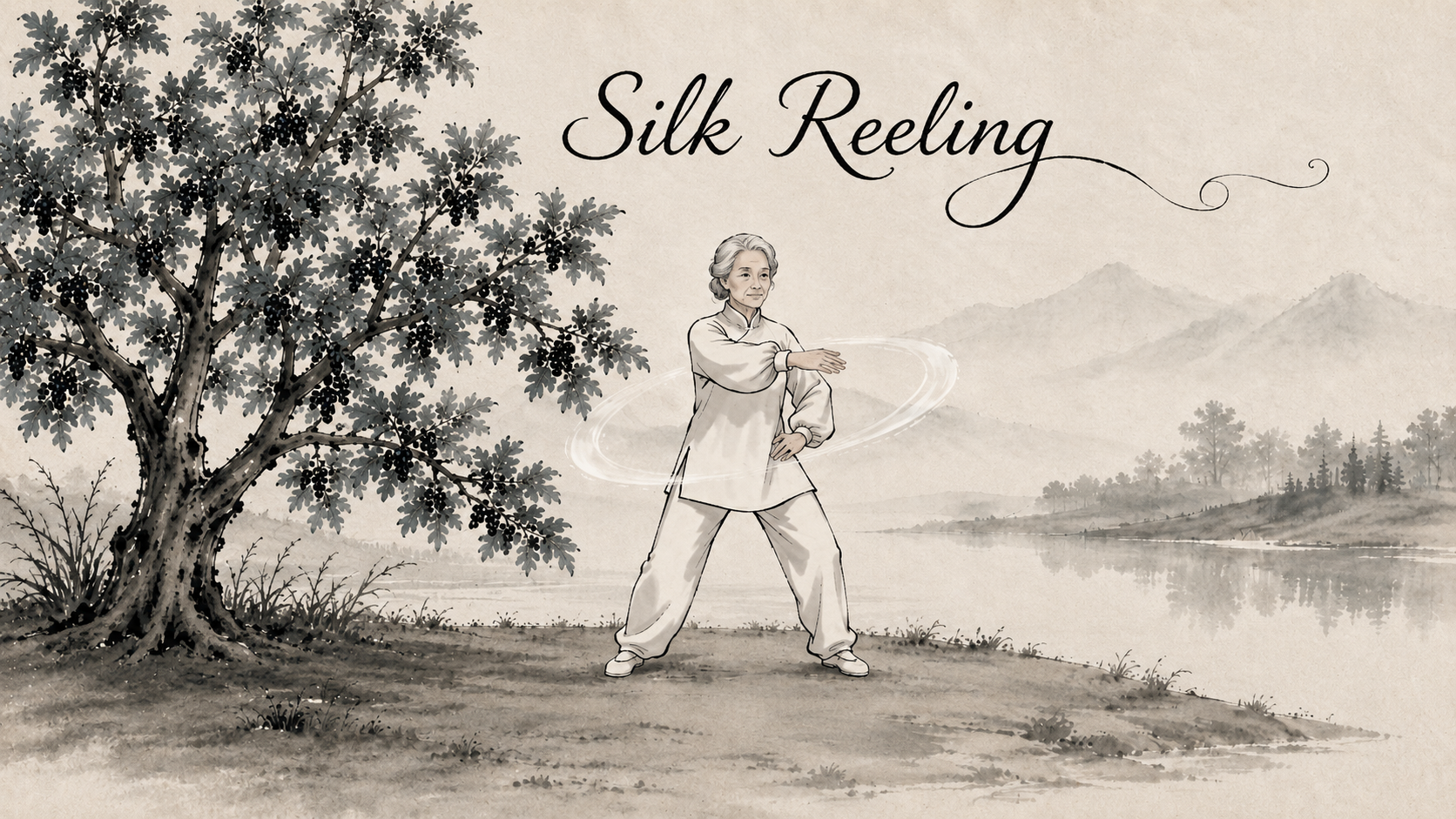
🗨️ “The form should be as if drawing silk—smooth, continuous, and connected.”
8. Neck and Head – Suspended from Above
Visualize a silk thread lifting you from the Baihui point (the crown point at the top of the head).
- Chin slightly tucked—lengthening the neck.
- Keep the head upright without stiffness.
- Try this: Imagine the top of your head floating up while your shoulders stay heavy and relaxed.
🗨️ “Let the shen (spirit) rise to the top.”
9. Eyes and Gaze – Focused and Internal
Your gaze should follow your movements calmly and mindfully.
- Soften your focus—don’t stare or dart.
- Align visual attention with Yi (intention or mindful attention).
- Try this: Keep your eyes soft and let your attention rest on what you’re doing right now—shifting, turning, and breathing.
🗨️ “The spirit is the commander and the body is subordinate.”
10. Breath – Deep, Natural, and Synchronized
Breathe through the nose and coordinate it with movement.
- Inhale when rising or opening; exhale when sinking or closing.
- Let the breath be long, quiet, and continuous.
- Try this: Don’t force the breath—just notice it and let it gradually become smoother as you relax.
🗨️ “Use stillness to control movement. Slower is better.”
Visualization Tips for Standing Practice
If you’re new to these postural cues, here are a few helpful images to guide your standing alignment:
- 🎈 String from the crown: Encourages upright, relaxed posture
- 🪨 Rooted feet: Picture energy sinking into the Earth
- 🧊 Holding small balls under arms and in hands: Keeps the arms rounded and soft
- 🌊 Breath as a wave: Smooth, natural rhythm rising and falling
Putting It Into Practice: A Simple Checklist
- Feet rooted and weight clearly shifting (substantial/insubstantial)
- Knees soft (not locked) and tracking comfortably over the feet
- Hips and kua relaxed; waist free to turn and shift
- Spine upright and long; chest relaxed (not puffed or collapsed)
- Shoulders and elbows sunk; arms rounded and connected
- Breath quiet and natural; movement smooth and unforced
Beginner Version: Practice These First
- Feet feel grounded
- Knees are soft
- Spine feels tall
- Shoulders relax downward
- Breath stays natural
Posture Reflects your Practice
Posture improves gradually in Tai Chi. You don’t need to “get it right” all at once—small changes in how you stand, breathe, and relax your shoulders can make your practice feel steadier and more comfortable over time. Practice gently, stay curious, and let the basics become familiar.
If you’d like help applying these posture cues in a supportive setting, we work on these fundamentals step-by-step in our Tucson beginner Tai Chi classes.
Learn more:
- Beginner Tai Chi in Tucson: /beginner-tai-chi-classes-tucson
- Current class schedule: /schedule
Frequently Asked Questions
Why is Tai Chi posture so detailed?
Because small adjustments add up. Tai Chi does not rely only on muscle strength. Good alignment helps the whole body move together.
What does it mean to “unlock” the knees?
To “unlock” your knees means to gently bend them so they’re not locked or hyperextended. Many practitioners find this helps the legs feel more springy and comfortable during shifting and turning.
How does breathing affect Tai Chi posture?
Breath and posture are connected in Tai Chi. Many practitioners find that when the body is aligned and relaxed, the breath becomes quieter and more natural, and movement feels smoother. In Tai Chi tradition, this is often described as supporting Qi (vital energy) circulation.
What is the significance of imagining a string lifting from the top of the head?
This classic visualization technique—imagining a silk thread pulling upward from the Baihui point (top of the head)—encourages length in the spine without creating tension. It promotes upright posture, balance, and mental clarity, helping the spirit (Shen) rise and settle peacefully.
Why use the imagery of balls in the hands and under the arms?
Visualizing holding small balls or a Qi ball helps create rounded, relaxed arms. This prevents collapse or overextension of the joints and supports the flow of internal energy. The shape feels alive, connected, and springy—key qualities in Tai Chi’s flowing forms.
How should the shoulders feel during proper Tai Chi posture?
Shoulders should be naturally relaxed and dropped, not lifted or tense. Tension in the shoulders can block energy flow from the spine to the arms. Keeping them soft allows the elbows to hang, the chest to open, and the movement to remain grounded and expressive.
What role does the Dantian play in Tai Chi posture?
The lower Dantian (located a few inches below the navel) is considered the center of gravity and energy in Tai Chi. Relaxing the abdomen and breathing into this area helps sink the Qi, stabilize the posture, and generate internal strength.
Should my eyes be open or closed during Tai Chi practice?
Your eyes should be softly open with a calm, gentle gaze that follows the direction of your movement. Avoid fixating. This supports mindful focus and alignment with your intent (Yi). The gaze should reflect the inner stillness and awareness you’re cultivating.
How long should I practice standing posture?
Even a few minutes of mindful standing each day can build awareness and improve alignment. Over time, practitioners may hold standing postures (Zhan Zhuang) for 5–30 minutes to build internal strength and presence. Start with shorter sessions and gradually increase as you develop comfort and consistency.
Is proper posture really that important if I’m just starting out?
Absolutely. Proper posture forms the foundation for everything in Tai Chi—balance, movement, breath, energy flow, and even mental clarity. Starting with good posture habits will help you progress faster, avoid injury, and experience deeper benefits from your practice.
Bridging Theory to Practice
Try This Today: The Substantial-Insubstantial Weight Shift
2 minutes
Somatic Intent: Feel the clear distinction between 100% full and 100% empty support.
- 1Stand with feet shoulder-width apart, parallel, and knees soft.
- 2Slowly pour 100% of your weight into your right foot without tilting your upper torso.
- 3Check that your left foot is completely free of weight - it can tap or hover gently.
- 4Pour your weight across the bridge to the left foot. Repeat 6 smooth, unbroken shifts.
* Always work within your personal comfort zone. There is never any forcing, straining, or breath-holding in Tai Chi.
Old Pueblo Tai Chi — Traditional Yang & Sun Style Classes
Culture Connects Studio • 3000 E. 22nd Street, Tucson, AZ 85713 • https://oldpueblotaichi.com
Questions about classes? Contact Dan Kimball at dan@oldpueblotaichi.com or (520) 222-8232
Practice Newsletter
Stay Connected with Old Pueblo Tai Chi
Get new articles, practical movement guides, seasonal health insights, and Tucson class announcements delivered to your inbox.
Experience the Practice in Person
Reading about Tai Chi is great, but the true benefits come from moving. Join our welcoming morning classes at Culture Connects Studio in Midtown Tucson.
Culture Connects Studio • 3000 E 22nd St, Tucson, AZ 85713 • Mondays & Wednesdays 10:00 AM – 11:00 AM (Doors open 9:45 AM, arrive 10–15 min early)