Lift Hands, Press Heel → White Crane Spreads Wings
Lift Hands, Press Heel → White Crane Spreads Wings is a classic Tai Chi transition that trains smooth weight shifting, coordinated rising/sinking hands, and whole-body connection. In this guide, you’ll get clear step-by-step checkpoints for balance and hand pathways so the sequence feels stable, light, and connected (not arm-driven). It often appears after Grasp the Bird’s Tail in many Yang-style and Wudang-influenced forms, though sequence details can vary by lineage.
This guide is especially helpful for beginners learning Tai Chi form transitions and for returning students refining balance, hand pathways, and relaxed whole-body movement.
Quick Answer
This sequence trains rooting, timing, and coordinated “one hand rises / one hand sinks” mechanics while your weight shifts and the torso subtly turns. Done well, it can help you move with more balance, clarity, and relaxed power.
Quick Checkpoints
- Root before moving
- Relax the shoulders
- Let the waist lead
- Separate one hand rising / one hand sinking
- Finish balanced and upright
Part 1: Lift Hands, Press Heel (Ti Shou Shang Shi, 提手上势)
Purpose
A transitional movement that receives or intercepts incoming force and positions your structure for the next technique.
Step-by-Step
Note: Footwork and hand positions can reverse depending on which side of the form you’re practicing. In this example, focus on the principles more than right/left specifics.
- Set your base
- Let your weight settle into the standing leg.
- Keep the crown lifted, tailbone heavy, and chest soft.
- Lift Hands
- Let both hands rise in front of the chest with a soft curve (as if holding a large ball).
- Keep shoulders relaxed and elbows dropped.
- Lead from the waist/dantian rather than lifting with the arms.
- Breathe naturally; some lineages coordinate an inhale here.
- Press Heel (step and place)
- Shift smoothly as you prepare to step.
- Place the heel first with control (think “placing,” not stomping).
- Keep the step quiet and rooted as the torso stays upright and calm.
Common Mistakes
- Raising the shoulders or stiffening the chest
- Overstepping (losing balance or “reaching”)
- Moving the arms without waist/torso coordination
- Collapsing wrists or dropping elbows too early
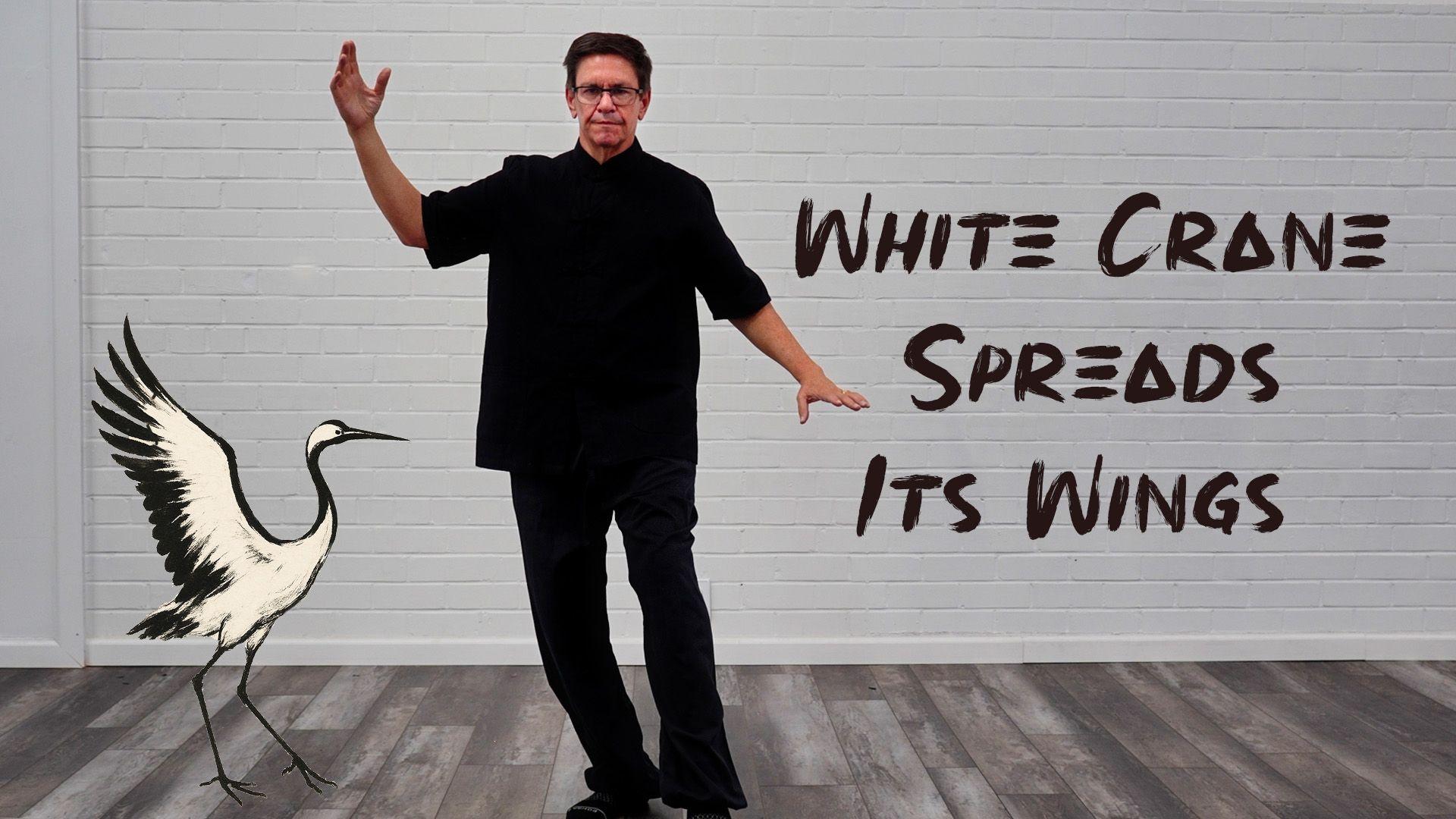
Part 2: White Crane Spreads Wings (Bai He Liang Chi, 白鹤亮翅)
What It Trains
- Balance and single-leg stability
- Coordinated upper/lower body movement (whole-body connection)
- Clear rising/sinking hand pathways with relaxed intent
Step-by-Step
Note: Exact angles and timing can vary by lineage. Use these as checkpoints and adjust to your form.
- Prepare the frame
- From the end of Lift Hands, keep the body tall and the shoulders soft.
- Allow a subtle turning from the waist as you organize the hands.
- “Stack” and separate
- One hand settles into a softer, lower guard while the other organizes above it.
- Keep the elbows heavy and the fingers relaxed (no clawing).
- Rise and lower (connected through the torso)
- Let one hand rise toward head/upper-chest level (palm inward, elbow soft).
- Let the opposite hand sink toward the hip/side (palm down or neutral).
- Feel the connection through the back and waist rather than isolating the arms.
- Shift and open
- As the hands separate, shift weight with control.
- Let the torso open slightly in the direction of movement without leaning.
- Finish poised
- Keep the spine upright, gaze forward, and breath calm.
- Depending on the version you practice, the non-weight-bearing foot may toe-touch lightly for balance.
Common Mistakes and Corrections (Both Parts)
- Rushing the weight shift: move the weight smoothly; don’t “jump” into the step.
- Tension in hands/elbows/shoulders: soften the joints so the movement stays connected.
- Arm-led movement: initiate from the waist and let the arms follow.
- Overreaching with the high hand: keep the shoulder down and let the rise come from whole-body alignment.
- Unstable finish: shorten the stance and rebuild the root before continuing.
Practice Tips
- Practice slowly first; slow speed builds control and proprioception.
- Work in front of a mirror or record from the side to check: shoulders down, elbows soft, spine upright.
- Coordinate breath gently: many practitioners inhale as the body opens/rises and exhale as the weight settles (adjust to your lineage).
- Reduce range of motion if you feel strain—especially in the shoulders or knees.
For another classic sequence, see Brush the Knee and Play Pipa.
Closing Reflection
White Crane Spreads Wings is often described as a “light” posture, but it’s light because it’s rooted. When the base is steady and the waist leads, the rising and sinking hands can feel effortless and precise.
Learn Tai Chi in Tucson, Arizona
If you’d like help practicing transitions like Lift Hands, Press Heel and White Crane Spreads Wings with hands-on feedback, join a beginner-friendly Tai Chi class in Tucson, Arizona.
View the current class schedule here: /schedule
New to Tai Chi? Start here: /beginner-tai-chi-classes-tucson
Bridging Theory to Practice
Try This Today: The Centering Breath of Stillness
60 seconds
Somatic Intent: Pause right now to anchor the wisdom of this article directly in your physical body.
- 1Rest both palms over your navel center (Dan Tian).
- 2Soften your gaze and allow your shoulders to drop away from your ears.
- 3Inhale softly into your palms, sensing warmth expanding in the lower abdomen.
- 4Exhale and feel your heels connect into the ground below.
* Always work within your personal comfort zone. There is never any forcing, straining, or breath-holding in Tai Chi.
Old Pueblo Tai Chi — Traditional Yang & Sun Style Classes
Culture Connects Studio • 3000 E. 22nd Street, Tucson, AZ 85713 • https://oldpueblotaichi.com
Questions about classes? Contact Dan Kimball at dan@oldpueblotaichi.com or (520) 222-8232
Practice Newsletter
Stay Connected with Old Pueblo Tai Chi
Get new articles, practical movement guides, seasonal health insights, and Tucson class announcements delivered to your inbox.
Experience the Practice in Person
Reading about Tai Chi is great, but the true benefits come from moving. Join our welcoming morning classes at Culture Connects Studio in Midtown Tucson.
Culture Connects Studio • 3000 E 22nd St, Tucson, AZ 85713 • Mondays & Wednesdays 10:00 AM – 11:00 AM (Doors open 9:45 AM, arrive 10–15 min early)