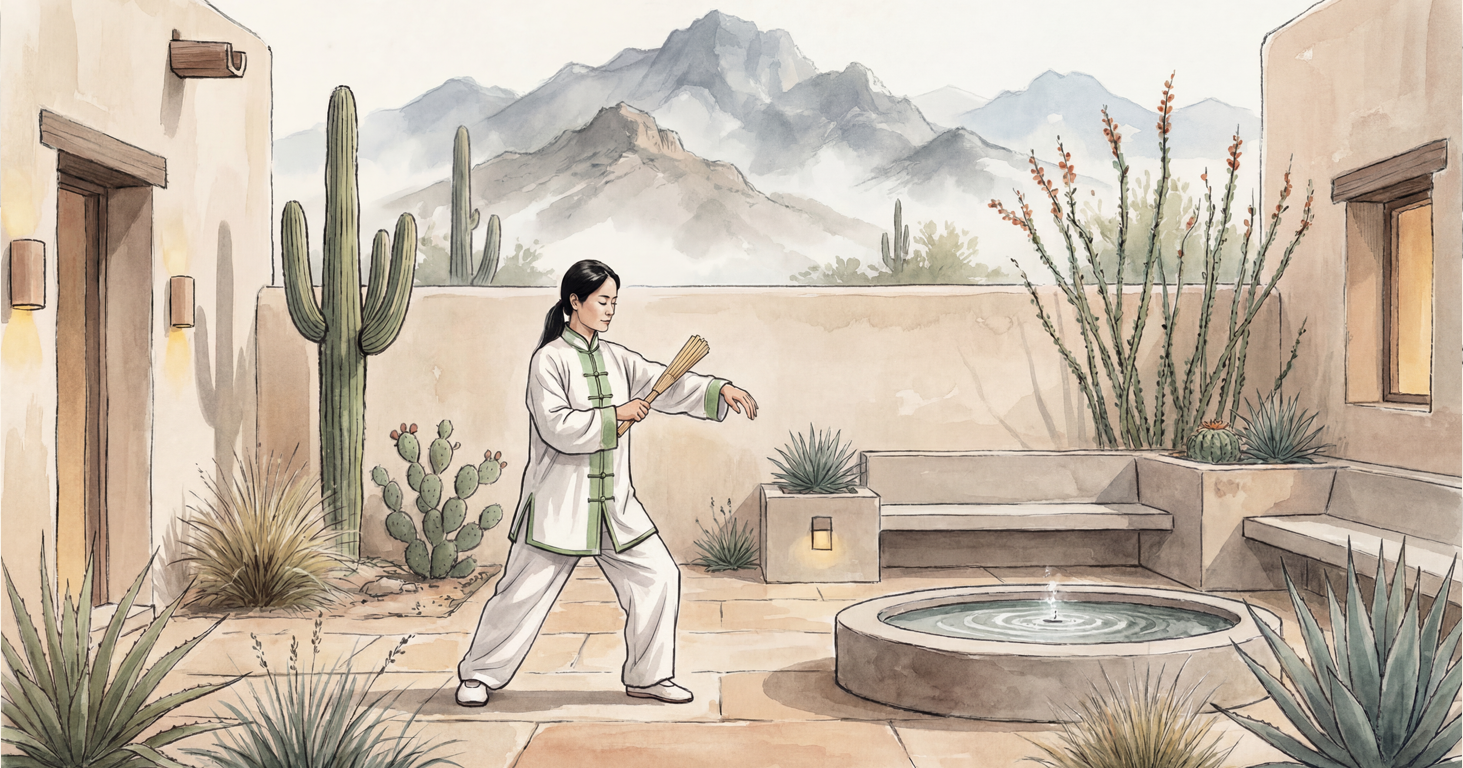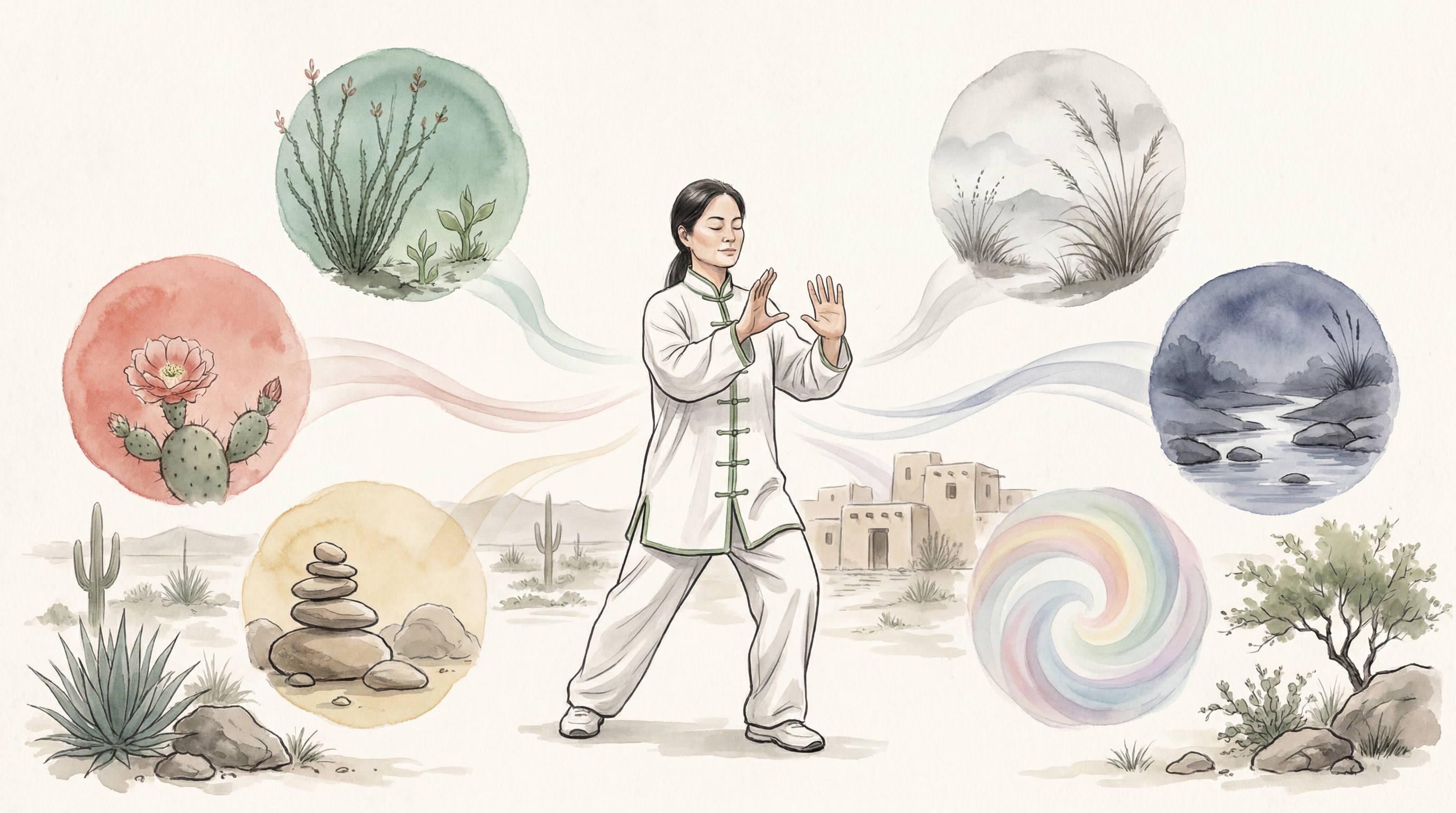
Eight Pieces of Brocade, or Ba Duan Jin, is one of the most widely practiced and beginner-friendly forms of Qigong—a set of gentle movements coordinated with breath and relaxed attention. (New to the term? See: What is Qigong?.)
Eight Pieces of Brocade Qigong (Ba Duan Jin)
Ancient Wisdom for Modern Wellness
Eight Pieces of Brocade, or Ba Duan Jin, is one of the most widely practiced and beginner-friendly forms of Qigong—a set of gentle movements coordinated with breath and relaxed attention. (New to the term? See: What is Qigong?.)
Quick Answer: What Is Eight Pieces of Brocade?
- Eight Pieces of Brocade, or Ba Duan Jin, is a classic Qigong routine made of eight gentle movements coordinated with breath and relaxed attention.
- Many people practice it to support mobility, balance, body awareness, and a calmer, more grounded feeling.
- It is beginner-friendly, adaptable, and often practiced in 10–20 minutes.
- Beginners can start with 5–10 minutes, 3–5 days per week, and build gradually as the movements become familiar.
- This guide covers the history, key principles, and a step-by-step breakdown of each movement.
What Is Ba Duan Jin?
The name “Brocade” refers to a richly woven silk fabric—often used as a metaphor for how each movement weaves together posture, breath, and intention into a practice that can feel nourishing for body and mind.

A Short History of Ba Duan Jin
Legend attributes the creation of the Eight Pieces of Brocade to General Yue Fei, the Song dynasty military leader. This attribution is part of the traditional story of Ba Duan Jin, though the exact historical origins are difficult to verify.
Today, the Eight Pieces of Brocade is embraced by people of all ages and fitness levels for its graceful, flowing movements and practical, whole-body feel.
Ba Duan Jin is often practiced to support flexibility, balance, and a steadier, calmer baseline—especially when approached with relaxed breathing and mindful movement.

Here is a short demonstration of the Eight Pieces of Brocade practice:
Historical and Philosophical Foundations
Ba Duan Jin belongs to the broader family of Chinese Dao Yin and Qigong-style practices.
One important historical reference point is the Dao Yin Tu, a silk chart of guided exercises excavated from Mawangdui Tomb 3 in Changsha, Hunan. The tomb is commonly dated to 168 BCE, and the chart is often cited as an early visual record of Chinese therapeutic movement practices (as part of a broader movement-practice tradition, not as direct proof that Ba Duan Jin existed in that exact form at that time).

Key Principles: Posture, Breath, and Intention
Within Traditional Chinese Medicine (TCM) theory and Daoist/internal arts traditions, Ba Duan Jin is often explained through the “three treasures” of health:
- Jing (Essence): The physical substance and foundation of vitality.
- Qi (Energy): The life force or “vital breath” that animates all functions.
- Shen (Spirit): The mind, consciousness, and spiritual clarity.
In these traditions, practitioners often describe the practice as training:
- Relaxed posture and alignment
- Breath awareness
- Focused attention (Yi / intention)
TCM descriptions of Qi and meridians are part of a traditional framework. Many modern students approach these ideas as experiential language for coordinating breath, movement, and attention rather than as medical anatomy.
Foundational Elements of Ba Duan Jin
- Posture: In Qigong theory, posture is used to ‘open’ the body and support smoother breathing, movement, and awareness.
- Breathwork: Slow, calm breathing that many practitioners find helps with relaxation and steadiness.
- Intention (Yi): A gentle focus that helps link attention to movement.

Note: The focus areas below come from Traditional Chinese Medicine (TCM) theory and are offered as a traditional practice lens, not as medical diagnosis or treatment.
Movement Breakdown: The Eight Pieces
Movement titles vary by lineage and translation. For example, “Drawing the Bow to Shoot the Hawk” is also commonly rendered as “Shoot the Eagle” or similar variations.
1. Two Hands Hold Up the Heavens (Shuang Shou Tuo Tian)
- Focus: Triple Burner (San Jiao)
- Purpose: Traditionally associated with opening the torso, coordinating breath, and encouraging a feeling of spaciousness through the chest, abdomen, and pelvis.
- Movement: Arms rise up centerline with an inhale, palms turn upward overhead; raise heels for deeper stretch; exhale to lower.
2. Drawing the Bow to Shoot the Hawk (Kai Gong Si She Diao)
- Focus: Kidneys and Spleen
- Purpose: Often practiced to build leg strength and steady posture, and many students find the coordinated breath and focus can encourage a calmer, more settled feeling.
- Movement: Sink into horse stance, draw bow to the side, exhale forcefully; alternate sides.
3. Separating Heaven and Earth (Tiao Li Pi Wei Xu Dan Ju)
- Focus: Spleen and Stomach
- Purpose: In Qigong/TCM theory, this movement is often associated with supporting harmony and ease through the middle of the body; many practitioners use it as a gentle way to coordinate breath with opening and closing.
- Movement: Hands press in opposite directions (one up, one down); alternate sides with a gentle stretch.
4. Wise Owl Gazes Backwards (Wu Lao Qi Shang Wang Hou Qiao)
- Focus: Neck, Eyes, and Spine
- Purpose: Often practiced to release neck/upper-back tension and build awareness of posture. In TCM theory, it’s also associated with balancing the effects of stress and the “Seven Emotions.”
- Movement: Gaze over shoulders with an extended neck rotation; hands press and scoop.
5. Sway the Head and Shake the Tail (Yao Tou Bai Wei Qu Xin Huo)
- Focus: Heart and Lungs
- Purpose: In TCM theory, this is traditionally associated with clearing excess “Heart Fire (Xin Huo).” Many practitioners use it to loosen the spine and hips and to settle the breath.
- Movement: Twist torso side-to-side in low horse stance while maintaining balance and spinal integrity.
6. Two Hands Hold the Feet to Strengthen the Kidneys and Waist (Liang Shou Pan Zu Gu Shen Yao)
- Focus: Kidneys and Urinary Bladder Meridian
- Purpose: Often practiced to lengthen the back body and gently strengthen the hips and low back. In TCM theory, it is associated with nourishing Jing (essence) and supporting the Kidney system.
- Movement: Stretch upward, then fold forward tracing meridian paths; rise with intention, guiding Qi through the spine.
7. Clenching the Fists and Staring Fiercely (Cuan Quan Nu Mu Zeng Qi Li)
- Focus: Liver and Wood Element
- Purpose: Often practiced to build grounded strength and confidence. In TCM/Qigong theory, it’s associated with supporting the Liver system and easing “Liver Qi” stagnation.
- Movement: Punch slowly with intense gaze; exhale deliberately; alternate sides with mindful intent.
8. Bouncing on the Heels to Dispel Illness (Bei Hou Qi Dian Bai Bing Xiao)
- Focus: Whole body, lymphatic and circulatory systems
- Purpose: Traditionally associated with waking up the whole body and encouraging circulation and steadiness. Many people experience it as energizing and “refreshing.”
- Movement: Rise slowly onto toes with inhale, drop heels to ground with a soft bounce and exhale.
Benefits of Eight Pieces of Brocade
People practice Ba Duan Jin for many reasons. While experiences vary, many practitioners report benefits such as:
- Supporting balance, flexibility, and functional strength
- Encouraging body awareness and a calmer, more grounded baseline
- Supporting relaxation, steadier breathing, and overall well-being
- In TCM/Qigong theory, nourishing and balancing the internal organ systems (as a traditional framework)
- Supporting a sense of vitality, circulation, and whole-body coordination
- Helping the spine and joints feel looser and more comfortable over time (without forcing range of motion)
The Eight Pieces of Brocade Qigong is a timeless and profound method of self-cultivation. It embodies the Daoist ideal of harmony between Heaven, Earth, and Humanity, and can be practiced daily to restore and maintain vitality across all levels—body, breath, and spirit.
Whether you are new to Qigong or returning to deepen your practice, Ba Duan Jin offers a beautifully accessible and effective foundation for health and well-being.
How to Practice Safely
- Start with a comfortable range of motion.
- Move slowly and avoid forcing stretches.
- Keep the knees soft and the breath natural.
- Practice for a few minutes at first, then build gradually.
- If you feel sharp pain, dizziness, or unusual discomfort, stop and rest.
- If you have medical, balance, joint, or mobility concerns, check with a qualified healthcare professional before beginning a new movement practice.
Beginner FAQ
How long does Ba Duan Jin take?
Many people practice it in about 10–20 minutes. Beginners can also do a shorter 5–10 minute version and build gradually.
How often should beginners practice?
If it feels good, try 3–5 days per week as a gentle starting point—but even occasional practice can be worthwhile.
Do I need to memorize all 8 movements?
No. You can start with 1–3 movements, repeat them slowly, and add more over time.
Can I do Ba Duan Jin seated?
Often, yes. Many students practice a seated version with smaller, comfortable movements—especially while learning.
Is Ba Duan Jin good for beginners who feel stiff or out of shape?
It’s commonly taught as a beginner-friendly practice. Start with small ranges of motion, move slowly, and keep it comfortable. (If you’re brand new to internal arts, you might also enjoy simple standing meditation practices.)
Learn Qigong in Tucson
If you’d like to learn Ba Duan Jin or other Qigong practices with beginner-friendly instruction, Old Pueblo Tai Chi offers classes in Tucson.
Final Thoughts
Bridging Theory to Practice
Try This Today: Wave Breathing for Nervous System Ease
90 seconds
Somatic Intent: Coordinate soft hand movement with the natural rhythm of your breath.
- 1Stand or sit upright with hands resting near the lower abdomen.
- 2Inhale gently through the nose as your hands float softly up toward your heart.
- 3Turn palms downward and exhale smoothly as hands drift back down to the lower abdomen.
- 4Repeat for 5 slow, unhurried breathing cycles.
* Always work within your personal comfort zone. There is never any forcing, straining, or breath-holding in Tai Chi.
Old Pueblo Tai Chi — Traditional Yang & Sun Style Classes
Culture Connects Studio • 3000 E. 22nd Street, Tucson, AZ 85713 • https://oldpueblotaichi.com
Questions about classes? Contact Dan Kimball at dan@oldpueblotaichi.com or (520) 222-8232
Practice Newsletter
Stay Connected with Old Pueblo Tai Chi
Get new articles, practical movement guides, seasonal health insights, and Tucson class announcements delivered to your inbox.
Experience the Practice in Person
Reading about Tai Chi is great, but the true benefits come from moving. Join our welcoming morning classes at Culture Connects Studio in Midtown Tucson.
Culture Connects Studio • 3000 E 22nd St, Tucson, AZ 85713 • Mondays & Wednesdays 10:00 AM – 11:00 AM (Doors open 9:45 AM, arrive 10–15 min early)